
Tag: Lifestyle

  • The Silver Paradox: Why Your Grey Hair is Actually Your Fastest-Growing Hair

    The Silver Paradox: Why Your Grey Hair is Actually Your Fastest-Growing Hair

    Key Takeaways

    • Grey hair can actually grow faster than your normal hair. Studies suggest grey hairs may grow about 10% faster than pigmented hairs.
    • Grey hairs are usually thicker. That’s why they often feel coarse, wiry, or harder to manage.
    • Your hair follicles are still healthy. Going grey doesn’t mean your hair is dying—it simply means it has stopped making its natural color (melanin).
    • Grey hair stays in the growth phase longer. This allows individual grey hairs to grow longer before they eventually fall out.
    • Grey hair is more likely to stick out. Because it’s thicker and loses moisture more quickly, it can become frizzy, dry, and difficult to style.
    • Too much stress inside the hair follicle may cause greying. As the follicle works hard to grow hair, it produces harmful molecules called free radicals, which can damage the cells that give hair its color.
    • The follicle survives, but the color doesn’t. Even after the pigment-producing cells die, the follicle keeps making new hair—just without the color.
    • Not everyone is half grey by age 50. The old saying that “50% of people have 50% grey hair by age 50” isn’t true for most people. The actual number is much lower.

    Read Also: Onion Juice for Hair Growth: Evidence, How It Works, Step-by-Step Guide, Benefits & Risks

    For decades, we have viewed the arrival of grey hair as a biological “winding down”—a sign that our hair follicles are losing their vitality as we age. However, recent dermatological research has uncovered a fascinating biological contradiction known as the Silver Paradox. Far from being a sign of follicular exhaustion, unpigmented (white or grey) hair is often more physically active, thicker, and faster-growing than the pigmented hair it replaces.

    Read Also: The Bitter Truth: Sugary Drinks and Hair Loss in Men

    Faster, Longer, and Stronger

    Scientific observations have consistently shown that white hair follicles do not follow the expected trajectory of age-related decline. Clinical studies indicate that the growth rate of unpigmented hair is significantly higher—approximately 10% faster—than that of pigmented hair. This phenomenon is often most visible in male eyebrows, where the longest, most prominent hairs are frequently those that have lost their pigment.

    This “supercharged” growth isn’t just about speed; it is also about volume. Measurements of hair shaft diameter reveal that white hairs are significantly thicker and coarser than their pigmented counterparts. While we often perceive grey hair as “thinning,” the individual silver strands are actually more robust in terms of cross-sectional area.

    The Molecular “Gas Pedal”

    What is happening inside the follicle to cause this surge in activity? The answer lies in the upregulation of specific genes and proteins related to hair structure and growth.

    Microarray and RT-PCR analyses have shown that white hair follicles significantly increase the production of keratins and Keratin-Associated Proteins (KRTAPs). These proteins are the primary structural components of the hair shaft, and their upregulation suggests that grey hair is in a state of active, and even excessive, growth.

    Furthermore, the balance of growth factors—the chemical signals that tell hair when to grow and when to stop—shifts dramatically in unpigmented hair. Researchers found that white hair follicles show:

    • Upregulation of FGF7: A growth promoter (also known as Keratinocyte Growth Factor) that stimulates cell proliferation.
    • Downregulation of FGF5: A growth inhibitor that typically signals the hair to stop growing and enter the “shedding” phase.

    By essentially “stepping on the gas” with FGF7 and “releasing the brake” with FGF5, the white hair follicle remains in the active growth phase (anagen) longer and more intensely than pigmented follicles.

    Why Grey Hair Feels “Unruly”

    This hyperactivity explains the common beauty complaint that grey hair is “wild” or difficult to manage. Because white hair has a higher concentration of KRTAPs and a thicker diameter, it possesses a higher bending modulus and greater stiffness. It also exhibits different moisture kinetics; unpigmented hair tends to lose water faster, which can cause individual strands to “pop out” from the rest of the hair array as they dry and return to their natural curl.

    Read Also: 10 Foods Your Doctor Will Tell You to Avoid If You Have High Blood Pressure and Why

    The Cost of Speed: A Toxic Environment for Colour

    The most intriguing part of the Silver Paradox is that this very hyperactivity may be what kills the hair’s colour in the first place. Producing hair at such a high rate requires an immense amount of energy, which generates Reactive Oxygen Species (ROS), such as hydrogen peroxide (H2O2).

    While the hair follicle cells themselves remain viable and grow well under these conditions, the melanocytes—the delicate cells responsible for pigment—are highly sensitive to oxidative stress. The high levels of ROS created by “overdrive” growth eventually lead to melanocyte apoptosis (cell death), leaving the follicle healthy enough to grow hair, but too “toxic” to color it.

    Beyond the 50/50/50 Myth

    Despite the prevalence of greying, it is less common at age 50 than previously thought. The old “rule of thumb” stating that 50% of the population has 50% grey hair at age 50 is an oversimplification. Real-world surveys show that only 6% to 23% of people actually reach that level of coverage by age 50, depending on their ethnic origin and natural hair colour.

    In summary, your grey hair isn’t a sign that your follicles are giving up. Instead, they are running a biological marathon—growing faster and thicker than ever, even if they had to sacrifice their colour to maintain the pace.

  • Your Daily Routine Is Either Making You or Breaking You – The Choice Is Yours.

    Your Daily Routine Is Either Making You or Breaking You – The Choice Is Yours.

    Have you ever wondered why some people achieve their goals effortlessly? Meanwhile, other people stay stuck in the same cycle, year after year. It’s not luck, it’s not intelligence it is routine. As John C. Maxwell wisely said, “You’ll never change your life until you change something you do daily.”.That simple truth holds the power to completely reshape your destiny. If you’re tired of drifting through days without direction, it’s time to transform your life with a daily routine. So what are you changing today. You are ready to change something by coming to this blog post. You are also ready to learn something new. That is a good first step.

    Kindly follow our whatsapp channel

    ‎Follow the InfoHealthGh channel on WhatsApp: https://whatsapp.com/channel/0029Va7j1SgGE56e8pagc22u

    Every major transformation begins with small, consistent steps. Think about it. You don’t build a skyscraper overnight. You lay one brick at a time, every single day, until it stands tall. The same principle applies to your life. Your daily habits are the bricks of your future success, and your routine is the blueprint that guides their placement. Without it, even your biggest dreams will remain sketches on paper.

    Stop sitting around and wasting time. You’re dreaming about some big breakthrough but not taking action?. You need to master steering your day. Be productive and yield results.

    So how can you transform your life with a daily routine that fuels success, focus, and fulfillment? Let’s break it down.

    Read Also: 5 Places You Should Stop Wasting Your Energy Before It Drains Your Spirit.

    1. Your Routine Defines Your Direction

    Whether you realize it or not, you already have a routine. The question is — does it serve you or sabotage you? Most people live on autopilot, reacting to the world instead of creating their own structure. You wake up late, rush through your morning, check social media, skip breakfast, and spend the rest of the day trying to catch up. Sound familiar?

    Now imagine the opposite: waking up with purpose, dedicating your first hour to movement, mindfulness, and goal-setting. Instead of reacting, you’re leading. You’re creating momentum. Your daily routine becomes your silent mentor, guiding your energy toward what truly matters.

    The direction of your life is hidden in the details of your day. Change those details, and everything else follows.

    2. Consistency Beats Intensity Every Time

    Here’s a secret high achievers know: consistency always beats bursts of effort. You don’t have to spend three hours at the gym once a week — just twenty minutes a day is enough. You don’t have to meditate for an hour every morning — even five minutes of stillness can reset your mind. What matters isn’t how much you do, but how often you do it.

    Your brain and body thrive on rhythm. When you repeat positive actions daily, they become automatic, freeing your mental energy for creativity and problem-solving. That’s why developing a daily routine isn’t about perfection — it’s about repetition. The magic happens when you stick with it long enough for discipline to turn into habit.

    Remember this: big results come from small, repeated efforts. That’s how you transform your life with a daily routine.

    3. Mornings Are Your Launchpad

    If your mornings are chaotic, your day will follow that pattern. If your mornings are intentional, your entire day shifts in your favor. That’s why successful people guard their mornings like treasure. Your first hour sets the tone for everything else.

    Try this formula: Move. Meditate. Map.

    • Move: Get your body active — stretch, walk, or exercise.
    • Meditate: Spend a few minutes in silence, gratitude, or prayer.
    • Map: Write down your top three priorities for the day.

    This simple morning ritual acts as a mental reset, centering you before the world’s noise begins. When you start your day with purpose, productivity follows naturally.

    Read Also: Stop Drifting : Do a Life Audit Before Life Audits You

    4. Discipline Creates Freedom

    At first, building a routine feels restrictive — like a schedule chaining you down. But here’s the truth: discipline doesn’t confine you; it frees you. Without structure, you’re a slave to distraction. With structure, you take command of your time, your focus, and your future.

    The most successful people — from athletes to entrepreneurs — follow disciplined routines because they know freedom is the reward of structure. When you know what to do and when to do it, you stop wasting energy on decision fatigue and procrastination. That’s when life starts feeling lighter, not heavier.

    5. Progress Is Hidden in the Ordinary

    Most people expect transformation to look dramatic — sudden breakthroughs, instant success, viral moments. But real change rarely looks that way. It’s hidden in the small, ordinary actions you repeat daily. This includes reading a few pages, saving a little money, and saying no to distractions. It also involves showing up even when you don’t feel like it. Over time, those small wins compound into massive results.

    Think of your daily routine as your personal training ground. Every repetition builds strength. Every habit builds identity. Eventually, success stops being something you chase — it becomes something you embody.

    6. Design Your Routine Around Your Values

    A powerful routine isn’t copied from someone else — it’s crafted around what matters most to you. Maybe it’s health, family, learning, or faith. Whatever your priorities, anchor your habits around them. That’s how your routine becomes meaningful, not mechanical.

    Ask yourself:

    • What are the top three things that matter most to me?
    • What small actions can I do daily to honor those values?

    When your habits align with your heart, motivation becomes effortless.

    Read Also: Seven (7) things they won’t tell you about growing up

    The Takeaway

    Your future isn’t waiting to be discovered — it’s waiting to be designed. And the design starts with what you do every single day. The secret of success, happiness, and fulfillment isn’t in grand gestures but in consistent actions. Change your routine, and you’ll change your life.

    Remember John C. Maxwell’s timeless words: “You’ll never change your life until you change something you do daily.” Start today. Start small. But start. Because success doesn’t come to those who wish — it comes to those who show up for themselves every day.

    So, if you’re ready for a real transformation, there’s only one path forward — transform your life with a daily routine.

    Would you like me to create a Pinterest or Instagram post caption + flier text to promote this blog next?

  • Stop Drifting : Do a Life Audit Before Life Audits You

    Stop Drifting : Do a Life Audit Before Life Audits You

    Have you ever felt like you’re moving, but not really going anywhere? You wake up, rush through the motions, and go to bed wondering where the day or even the year went. You tell yourself things will change “soon,” but somehow, soon never comes.

    If that sounds familiar, then this is your wake-up call.

    It’s time to do a life audit.

    This isn’t about creating a wish list of dreams or another set of resolutions you’ll forget by February. Doing a life audit is about pausing long enough to understand where you truly are, what’s working, what’s draining you, and what needs to change now.

    Because here’s the truth: if you don’t do a life audit, life will do one for you.
    And trust me life’s version usually comes in the form of burnout, regret, or a crisis that forces you to stop.

    What Does It Mean to Do a Life Audit?

    A life audit is like a financial audit, but for your soul.
    It’s an honest check-in with yourself across the 8 key areas that shape your happiness, fulfillment, and growth:

    1. Health
    2. Finances
    3. Personal development
    4. Career
    5. Relationships
    6. Self-care
    7. Home
    8. Free time

    When you do a life audit, you’re asking:

    “Where am I right now, and what needs to change for me to live better?”

    Simple question. Transformative answers.

    Let’s unpack each area because your best life starts where honesty meets action.

    1. Health – The Foundation of Everything

    Without your health, nothing else stands. Yet it’s often the first thing we neglect.
    Ask yourself:

    • How do I feel when I wake up in the morning?
    • Am I eating to nourish or just to survive?
    • Do I move my body enough?
    • When was the last time I felt truly energetic?

    Start small. Drink more water. Sleep one extra hour. Replace scrolling time with stretching time. When you do a life audit, you’ll realize that your body keeps the score and it’s time to rewrite the script.

    2. Finances – The Mirror of Your Habits

    Money doesn’t buy happiness, but financial stress can steal it.
    Be brutally honest here. Are you managing your money, or is your money managing you?

    List your expenses, track your debts, and face your numbers without fear. Then, shift your mindset from spending to building. Create a savings plan, start that side hustle, or invest in a skill that earns you more tomorrow.

    Doing a life audit in your finances means regaining control and choosing peace over panic.

    3. Personal Development – Grow or Stay Stuck

    When was the last time you learned something new just for yourself?

    Growth doesn’t stop when school ends. It stops when curiosity dies.
    Read. Listen to podcasts. Take online courses. Learn a new language or skill. Reflect on your strengths and weaknesses.

    If you do a life audit today, you might realize that you’ve been running on autopilot reacting to life instead of intentionally creating it.
    Your mind needs feeding, too. Don’t starve it.

    4. Career – Alignment Over Achievement

    So many people chase promotions, titles, or bigger salaries but still feel empty.
    Ask yourself:

    • Am I proud of what I do every day?
    • Does my work align with my values?
    • Do I see a future where I’m growing, not just grinding?

    If the answer is “no,” it’s time to realign. Maybe it’s a career shift, maybe it’s setting boundaries, or maybe it’s starting your own thing.
    You spend most of your waking hours at work make sure it feeds your purpose, not just your bills.

    5. Relationships – Who You Keep Around You Shapes You

    Your circle can either lift you or drain you.
    When you do a life audit, assess your relationships honestly:
    Who supports your growth? Who only calls when they need something? Who makes you feel seen and valued?

    Distance doesn’t mean hate it means peace. Surround yourself with people who challenge you to be better, not bitter.
    And if love feels complicated, start by loving yourself first. The rest will follow.

    6. Self-Care – Not Luxury, But Maintenance

    Self-care isn’t bubble baths and candles (though those help). It’s setting boundaries, saying no, and resting when you need to.
    It’s taking care of your mind, body, and emotions before they collapse.

    When you do a life audit, check if you’re constantly pouring from an empty cup.
    Remember: You can’t show up for others if you’re constantly neglecting yourself.

    7. Home – Your Environment Reflects Your Energy

    Look around. Is your space inspiring or draining you?
    Clutter in your environment often mirrors clutter in your mind.

    Clean one corner. Organize your workspace. Add something that brings you joy, maybe a plant, a scent, or even sunlight.
    Doing a life audit means making your environment match the life you’re trying to build.

    Your home should be a place of peace, not pressure.

    8. Free Time – The True Test of Fulfillment

    What do you do when no one’s watching and you have nowhere to be?

    Many people realize during a life audit that they don’t really have free time they just have time filled with distractions.

    Do something that recharges you not numbs you. Paint, cycle, read, explore, meditate, or volunteer.
    Your free time is where your real self emerges. Protect it.

    How to Start Your Life Audit Today

    Getting started doesn’t have to be overwhelming. The key is honesty and intention — not perfection. Here’s how to do a life audit in a practical, powerful way:

    1. Rate Each Area (1–10): Be Brutally Honest

    Grab a notebook or open a digital journal and list the 8 key areas:
    Health, Finances, Personal Development, Career, Relationships, Self-Care, Home, and Free Time.

    Now, rate each one on a scale of 1 to 10, where:

    • 1 = “This area is draining me or feels completely off track.”
    • 10 = “I’m genuinely proud and fulfilled here.”

    Don’t overthink your score — go with your gut.
    The goal isn’t to judge yourself, but to see where the imbalance lies. Most people find that 2–3 areas dominate their focus while others are neglected. That’s your first clue to what needs attention.

    Tip: Visual learners can create a “Life Wheel” — draw a circle, divide it into 8 sections, and shade each area up to your rating. The uneven parts show where growth is needed.

    2. Write What’s Working and What’s Not: Awareness Is Power

    Once you’ve rated each area, reflect deeper:

    • What’s going right in this area?
    • What’s not working — and why?
    • What emotions come up when you think about this part of your life?

    For example:
    If your career rates a 4, maybe you’re good at your job but feel stuck or underappreciated. If relationships are a 6, maybe you have good friends but lack deeper emotional connections.

    Writing these truths out is uncomfortable, but necessary. Awareness is the first step to change. You can’t fix what you refuse to face.
    Journal Prompt:

    “If nothing changed in this area for the next year, how would that make me feel?”

    Your answer will tell you where to focus your energy first.

    3. Identify One Small Action Per Area: Tiny Steps, Massive Shifts

    Here’s where most people go wrong — they try to overhaul everything at once.
    But transformation doesn’t happen from grand gestures; it’s built on consistent, small actions that compound over time.

    Ask yourself:

    “What’s one realistic thing I can do this week to improve this area — even slightly?”

    Examples:

    • Health: Walk 30 minutes every morning or drink 2L of water daily.
    • Finances: Cancel unused subscriptions or set up an automatic savings transfer.
    • Career: Update your resume or enroll in a short course.
    • Relationships: Call a friend you haven’t spoken to in months.
    • Self-care: Set a digital boundary — no screens after 10 p.m.
    • Home: Declutter one drawer or shelf each day.
    • Free time: Dedicate one hour a week to something creative or joyful.

    Remember, progress happens when small steps become habits.
    By doing one meaningful thing per area, you’re creating a ripple effect that transforms your entire life.

    4. Revisit Every 3 Months: Progress Is a Journey, Not a One-Time Event

    Life changes — and so will your priorities. That’s why a life audit isn’t a one-and-done task; it’s an ongoing practice of reflection and realignment.

    Every three months, sit down and repeat the process.
    Ask:

    • What improved since my last audit?
    • What still feels out of balance?
    • What new goals or values have emerged?

    Celebrate your progress — no matter how small. If you’ve gone from a 4 to a 6 in any area, that’s real growth.

    Consistency builds clarity. Clarity builds confidence.
    And confidence builds a life that feels aligned — not accidental.

    Bonus Tip: Create a “Life Audit Vision Page”

    To keep your goals visible, create a one-page summary that lists:

    • Your scores for each area
    • Your top priorities
    • The one small action you’re committed to
    • A quote or affirmation that inspires you

    Place it somewhere you’ll see it daily — your journal, mirror, or phone wallpaper.
    It’s your personal reminder that you’re not stuck; you’re evolving.

    When you do a life audit intentionally, it stops being a task — and becomes a turning point.
    You start seeing your life not as chaos to survive, but as a system you can design and direct.

    Even 20 minutes of reflection can save you years of confusion.

    The Power of Doing a Life Audit

    When you do a life audit, something magical happens:
    You stop living reactively and start living intentionally.

    You begin to see patterns the habits that drain you, the routines that anchor you, and the dreams that still matter.
    You stop blaming luck or timing and start designing your own transformation.

    Remember, no one’s life is perfect. But those who evolve continuously take time to pause, reflect, and redirect.

    You can’t change what you don’t acknowledge.

    So take that pen, open that notebook, and begin your audit.
    Not tomorrow. Not next week. Today.

    Because every day you delay is one more day you live someone else’s version of your life instead of your own.

    Final Thought

    If you’ve been waiting for a sign, this is it.
    Do a life audit before life audits you.

    Don’t wait for burnout, heartbreak, or failure to make you stop and rethink.
    You deserve clarity, purpose, and peace and the first step is reflection.

    Your next chapter starts with one question:

    “What changes would make the biggest impact in my life right now?”

    Answer that, and your life will never look the same again.

  • 20 signs of a healthy relationship: Quick Test to Assess Your Relationship.

    20 signs of a healthy relationship: Quick Test to Assess Your Relationship.

    Building a lasting and fulfilling partnership takes effort, intention, and mutual commitment. Today’s world is full of complex interactions, recognizing the signs of a healthy relationship is essential for nurturing the connection you share.

    Read Also: 21 Brain-Boosting Foods That Sharpen Focus, Memory & Mental Clarity


    A truly strong bond isn’t just about grand gestures; it’s about the everyday moments and the fundamental ways you treat each other. If you’re wondering whether your relationship is on solid ground, here are 20 undeniable indicators that you and your partner are successfully building a robust, supportive, and healthy partnership. Take the Test Below !

    Healthy Relationship Self-Test

    Healthy Relationship Self-Test

    Answer each question honestly with Yes or No, then click Show Result to see your score and what it means.

    1. Conversations feel easy and natural.

    You don’t have to walk on eggshells or filter your thoughts excessively. Communication flows openly and honestly, making it one of the simplest yet strongest signs of a healthy relationship.

    2. You can disagree without fear of conflict.

    Disagreements are inevitable, but in a healthy relationship, they are constructive, not destructive. You know you can voice a differing opinion without the conversation escalating into a fight or fearing retaliation.

    3. Both of you make effort, not just one side.

    A relationship is a partnership. Effort must be balanced, demonstrating that both individuals are invested in its success and well-being.

    Read Also: How to Stop Sugar Cravings Naturally at Night: 7 Proven Strategies

    4. Trust grows stronger with time.

    Trust isn’t static; it’s continually built through reliability, honesty, and transparency. A strengthening sense of security is a powerful indicator of a thriving bond.

    5. Laughter is part of your daily bond.

    Sharing humor and moments of joy helps lighten the load of life and reinforces your emotional connection.

    6. You both feel comfortable being vulnerable.

    True intimacy requires the courage to be vulnerable. Feeling safe enough to share your fears, dreams, and imperfections is a crucial measure of your connection’s depth.
    Support, Respect, and Growth

    7. Respect is shown in words and actions.

    This extends beyond not insulting one another. It means actively listening, valuing your partner’s time, and honoring their choices, a core component of the signs of a healthy relationship.

    8. Goals are discussed and supported.

    You are each other’s biggest cheerleader. Whether for personal or joint ambitions, you discuss future plans and actively support the steps needed to achieve them.

    Read Also: The Role of Water in Weight Loss: What You Need to Know

    9. You lift each other during hard times.

    When the unexpected or difficult times hit, you act as a unified front, offering unwavering emotional and practical support.

    10. Space is given when needed, without guilt.

    You understand that individual time and interests are necessary. Requesting and taking space is understood as self-care, not a rejection of the other person.

    11. Mistakes are admitted and forgiven.

    No one is perfect. A healthy relationship allows for human error, followed by genuine apologies, accountability, and sincere forgiveness.

    12. Boundaries are clear and honored.

    Clear boundaries regarding emotional, physical, financial, or time commitments are set and consistently respected by both partners.

    13. Celebrations, big or small, are shared together.

    Sharing successes and milestones reinforces your bond and signifies that you celebrate each other’s happiness.

    14. There’s encouragement instead of criticism.

    Constructive feedback comes from a place of love and a desire to help the other person improve, not from a place of judgment or tearing them down. This is a fundamental way to spot the key signs of a healthy relationship.

    Read Also: What’s Your True Temperament? Take This Quick Self-Test to Find Out!

    15. You inspire each other to grow.

    Your partner brings out the best in you and motivates you to be a better version of yourself, not through pressure, but through inspiration.
    The Feeling of Security and Value

    16. Time together feels energizing, not exhausting.

    Spending time with your partner should refill your emotional cup, leaving you feeling refreshed and happy, rather than drained or anxious.

    17. Efforts are consistent, not occasional.

    The small, consistent efforts—the “how was your day” check-ins, the small acts of kindness—are the lifeblood of the relationship, not just occasional grand gestures.

    18. Gratitude is expressed regularly.

    You genuinely appreciate your partner and let them know it, regularly thanking them for their contributions and presence in your life.

    19. You feel seen, heard, and valued.

    This is a comprehensive measure of emotional security. You feel that your unique thoughts, feelings, and identity are fully recognized and appreciated by your partner.

    20. Love is shown in actions, not just words.

    While “I love you” is wonderful, true love is demonstrated through consistent, reliable, and thoughtful actions that prioritize the relationship and your partner’s well-being.

    Conclusion

    Recognizing these 20 signs of a healthy relationship provides a powerful roadmap for evaluating and improving your partnership. If you find your relationship exhibits a majority of these traits, congratulations—you are building a strong, enduring, and mutually beneficial foundation. If you see areas for improvement, use this list as a positive guide to spark honest conversations and intentional growth with your partner. A truly healthy relationship is a continuous journey, not a destination.

  • The Hard Truths Every Man Must Face to Build Himself Up

    The Hard Truths Every Man Must Face to Build Himself Up

    This is the Hard Truth Every Man Must Face to Build Himself. At some point, every man comes face-to-face with an uncomfortable truth: no one is coming to save you. Your life, your peace, and your progress are entirely your responsibility. No one’s going to hand you success or rescue you from struggle and that’s not meant to discourage you. It’s meant to wake you up.

    Because once you stop expecting help and start taking charge, everything changes.

    1. A Man Without Money Has No Voice

    Hard Truths Every Man Must Face to Build Himself Up

    You can have the biggest dreams and the kindest heart, but if your finances are in chaos, you’ll struggle to be heard. Money doesn’t buy happiness, but it does buy options which are freedom, stability, and the power to walk away from disrespect.

    Before you try to fix the world, fix your wallet.
    Learn how to budget, save, and build something that gives you peace of mind. When you handle your finances, you handle your future.

    Read Also:What’s Your True Temperament? Take This Quick Self-Test to Find Out!

    2. Going Through Hard Times Alone Builds You

    There’s a silent power in surviving your darkest days alone.
    When no one checks in, when you face pain in silence that’s when you find your real strength.

    Once you’ve gone through your worst time alone, you stop chasing people’s approval. You realize you don’t need everyone just a few real ones.

    Solitude isn’t punishment. It’s where you grow, rebuild, and become someone no storm can break.

    Read Also: Relieve Itchy Skin After Shower Naturally: Proven Remedies That Actually Work

    3. Fitness Is More Than Looks, It’s Discipline

    Hard Truths Every Man Must Face to Build Himself Up

    Here’s an uncomfortable truth: people respect you more when you’re in good shape.

    It’s not about vanity it’s about what your body says about your mindset. A man who’s disciplined enough to stay fit sends a message: I take care of myself.

    Go for morning runs, hit the gym, or do bodyweight workouts at home just stay consistent. Fitness builds confidence, focus, and self-respect.

    💪 Tip: Start small. 20 minutes a day can transform your mindset and energy levels.

    4. Look Sharp, Smell Good, Speak Calmly

    Respect often begins with presentation.

    Keep a clean haircut. Dress well not necessarily expensive, but intentional. Smell good. Talk slower. Smile when it matters.

    You don’t need to prove yourself loudly your presence should speak before you even open your mouth. When you look and carry yourself like a man who respects himself, people naturally respect you too.

    5. Accept the Loneliness, Then Fix Your Life

    Being a man sometimes means walking alone. But solitude doesn’t have to feel like isolation it’s the space where clarity lives.

    Be private. Move in silence. Build your life quietly. Accept that the path to becoming your best self often looks lonely, but the results will be worth it.

    No one is coming to save you. Your life is 100% your responsibility.

    Read Also: Your Body Is Begging for a Digital Detox: How it can Change Your Life.

    Become the Man You’d Look Up To

    Being a man isn’t about perfection it’s about progress.
    It’s about owning your flaws, fixing your weaknesses, and showing up every single day even when no one’s watching.

    Fix your finances. Strengthen your body. Protect your peace.
    Because at the end of the day, the world respects the man who respects himself.

  • What’s Your True Temperament? Take This Quick Self-Test to Find Out!

    What’s Your True Temperament? Take This Quick Self-Test to Find Out!

    Have you ever wondered why some people are naturally energetic while others remain calm no matter the situation? Or why certain friends thrive in leadership roles while others prefer deep reflection? The answer might lie in something ancient yet surprisingly accurate: the four temperaments. These personality blueprints, first described by Hippocrates and later echoed in biblical interpretations, still shape how we understand human behavior today. [TAKE THE TEMPERAMENT TEST BELOW.]

    Imagine unlocking the code to your own personality—knowing why you react to stress the way you do, what drives your motivation, and even how you connect with others. That’s the power of understanding temperaments. Whether you’re an extrovert who loves to be the life of the party or an introvert who thrives in peaceful settings, your temperament reveals the “why” behind your habits and choices.

    And here’s the best part: once you know your temperament, you can use that knowledge to strengthen relationships, manage emotions, and grow into the best version of yourself. So let’s dive into the fascinating world of temperaments and answer the big questions people often ask.

    What Are the 4 Types of Temperament?

    Traditionally, human personalities are grouped into four core temperaments:

    1. Sanguine – Lively, enthusiastic, and sociable. Sanguines love people, fun, and adventure.
    2. Choleric – Strong-willed, goal-driven, and natural leaders. Cholerics thrive on challenges and action.
    3. Melancholic – Thoughtful, analytical, and detail-oriented. Melancholics are deep thinkers with a sensitive nature.
    4. Phlegmatic – Calm, patient, and dependable. Phlegmatics value harmony and are natural peacemakers.

    Each temperament has its strengths and weaknesses, and most people are a blend of two or more.

    How Do I Know My Temperament Type?

    You can identify your temperament by observing your natural tendencies:

    • If you love being around people, get excited easily, and often act on impulse—you may be sanguine.
    • If you’re ambitious, decisive, and dislike being controlled—you’re likely choleric.
    • If you prefer routines, think deeply before acting, and notice details others miss—you may be melancholic.
    • If you remain calm under pressure, avoid conflict, and prefer stability—you may be phlegmatic.

    Many people also take a temperament test or personality quiz to confirm their type. These tests highlight your dominant traits and help you see how they play out in everyday life.

    This is just a test and cannot be used as definitive reflection of your temperament

    Self-Personalized Quiz

    Find Your Temperament: 12-Question Quick Test

    Rate how true each statement is for you. Your results will reveal your dominant temperament and your blend.

    0 / 12 answered
    ‎Follow the InfoHealthGh channel on WhatsApp: https://whatsapp.com/channel/0029Va7j1SgGE56e8pagc22u

    Read Also: Feeling Burnt Out? Take This Work-Related Stress Test

    How the Different Temperaments Relate to Each Other

    One of the coolest things about temperaments is seeing how they mix and match in real life. Friendships, marriages, or even work partnerships often work (or clash) because of these personality combos. Let’s break it down in a way that actually makes sense in everyday life.

    Sanguine + Choleric

    This duo is like fireworks—exciting, loud, and full of energy. The Sanguine brings the fun, while the Choleric brings the drive. Together, they can make things happen fast. The flip side? The Choleric might think the Sanguine is too “all over the place,” and the Sanguine might feel bossed around. But when they learn to respect each other, they’re unstoppable.

    Sanguine + Melancholic

    Talk about opposites attracting. The Sanguine is the “let’s go have fun” type, while the Melancholic is more of a “let’s think this through” kind of person. It actually balances out nicely—one adds excitement, the other adds depth. The challenge? Sanguine might see Melancholic as too serious, while Melancholic might think Sanguine never slows down. Still, it works when both appreciate what the other brings to the table.

    Sanguine + Phlegmatic

    This is a pretty chill combo. The Sanguine’s energy keeps life interesting, while the Phlegmatic’s calm nature keeps everything from spiraling out of control. They both love people and get along easily. Their weak spot? Neither loves making tough decisions, so things can drag when action is needed.

    Choleric + Melancholic

    These two are all about getting things done. The Choleric is the bold leader charging ahead, and the Melancholic is the detail-oriented planner making sure nothing falls apart. Together, they’re a powerhouse. But… the Choleric’s “let’s go now” can clash with the Melancholic’s “wait, let’s double-check.” If they find the middle ground, they can conquer just about anything.

    Choleric + Phlegmatic

    This pair is a classic balance. The Choleric brings fire and passion, while the Phlegmatic brings calm and peace. It works because one pushes forward and the other slows things down just enough. The tricky part? The Choleric might get frustrated that the Phlegmatic isn’t more assertive, while the Phlegmatic might feel steamrolled. Communication is key here.

    Melancholic + Phlegmatic

    This is the gentle, thoughtful combo. Both are steady, loyal, and prefer calm over chaos. The Melancholic brings ideas and standards, while the Phlegmatic brings patience and stability. Their downside? They can both be too passive, avoiding confrontation even when it’s needed. But if they learn to speak up, this is one of the most peaceful pairings around.

    👉 Bottom line: No temperament combo is “perfect” or “terrible.” Every mix has strengths and struggles. What makes relationships thrive is understanding each other and learning how to work with—not against—your differences.

    Check Your BMI Here : InfohealthGH BMI Calculator

    What Are the 4 Temperaments in the Bible?

    The Bible doesn’t explicitly list the four temperaments, but Christian thinkers through history have connected them with biblical characters and teachings and they are as follows:

    • Sanguine (Peter) – Outspoken, passionate, and quick to act.
    • Choleric (Paul) – Bold, determined, and strong leader.
    • Melancholic (Moses) – Deep, thoughtful, sometimes burdened with responsibility.
    • Phlegmatic (Abraham) – Patient, steady, and faithful.

    These connections show how temperaments reflect both strengths and struggles, reminding believers that God works through all personality types for His purpose.

    ✅ Takeaway: Whether you view them through psychology or scripture, temperaments offer timeless insight into who you are and how you relate to the world. Knowing yours is the first step to self-awareness, personal growth, and stronger relationships.

  • Is Drinking Water Before Bed Good or Bad?

    Is Drinking Water Before Bed Good or Bad?

    Is It Good to Drink Water Before Bed? What Science Says

    Is Drinking Water Before Bed Good or Bad

    Drinking enough water daily is essential for your body to function properly. But when it comes to drinking water right before bedtime, opinions differ. Some people sip a glass of water at night to stay hydrated, while others avoid it to prevent sleep disruptions. So, is drinking water before bed good or bad for your health? Let’s break it down.

    Read Also: What Happens If You Inject Yourself With Water?

    The Downsides of Drinking Water Before Bed

    1. Interrupted Sleep Cycle
      Normally, your body reduces urine production at night, letting you rest for 6–8 hours without interruption. Drinking a glass or two of water before bed can trigger frequent nighttime urination (nocturia), leading to broken sleep.
    2. Impact on Heart Health
      Sleep deprivation from waking up frequently can harm your heart. Research shows that adults who sleep fewer than 6 hours are at higher risk of high blood pressure, stroke, and heart disease.
    3. Age and Bladder Function
      As you age, conditions like diabetes, dementia, or prostate enlargement can make the bladder more sensitive. Drinking water right before bed increases the chance of waking up multiple times at night.

    Read Also: The Okra & Water Trend: What Science Says About Its Health Benefits

    Benefits of Drinking Water Before Bed

    Is Drinking Water Before Bed Good or Bad
    1. Improved Mood and Brain Function
      A 2014 study found that dehydration negatively affects mood and alertness. Staying hydrated before bed may help you feel calmer and more satisfied, which supports better sleep quality.
    2. A Gentle Detox
      Drinking warm water at night improves blood circulation, supports digestion, and helps the body flush out toxins through sweat and urine. Adding lemon can boost vitamin C intake and immunity.

    When Is the Best Time to Drink Water?

    The key is not to avoid water at night entirely but to time your hydration smartly:

    • Drink consistently throughout the day.
    • Have your last glass at least 1–2 hours before bed.
    • Drink water before and after exercise.
    • Add water-rich foods (fruits, veggies) to your meals.
    • Watch your urine color — pale yellow means you’re hydrated.

    Read Also: Benefits of dipping face in cold ice water first thing in the morning

    Final Outlook

    Water is essential for good health, but drinking it too close to bedtime may disrupt your sleep and increase nighttime bathroom trips. To get the benefits of hydration without the downsides, aim to drink enough during the day and finish your last glass at least two hours before sleep.

    If you often wake up dehydrated or have bladder issues, consult your doctor for a hydration plan tailored to your needs.

  • The Surprising Link Between Gut Health and Anxiety: How Your Digestive System Affects Your Mind

    The Surprising Link Between Gut Health and Anxiety: How Your Digestive System Affects Your Mind

    In recent years, science has revealed sothing fascinating: your gut and your brain are more closely connected than we ever imagined. Researchers now refer to the gut as the “second brain” because of how strongly it influences mood, stress, and even mental health conditions like anxiety. This connection—known as the gut-brain axis—helps explain the surprising link between gut health and anxiety.

    If you’ve ever had “butterflies” in your stomach before a big event, or digestive issues when feeling stressed, you’ve already experienced this connection firsthand. But how deep does it go? Can improving gut health reduce anxiety? And what practical steps can you take to heal this brain-gut relationship? Let’s dive in.

    Read Also: Five (5) signs you have too much salt in your system.

    the surprising link between gut health and anxiety

    How Does Gut Health Relate to Anxiety?

    Your gut is home to trillions of microbes collectively known as the gut microbiome. These bacteria, fungi, and other microorganisms aren’t just responsible for digestion—they play a major role in producing neurotransmitters like serotonin, dopamine, and GABA, which regulate mood and anxiety levels.

    • Serotonin: About 90% of your body’s serotonin (the “feel-good” chemical) is produced in the gut. Imbalances in gut bacteria can interfere with its production, potentially worsening anxiety.
    • Inflammation: An unhealthy gut can lead to chronic inflammation, which has been linked to anxiety and depression.
    • Stress response: The gut communicates directly with the brain through the vagus nerve, influencing the body’s stress response system. A disrupted gut may send “danger signals” to the brain, triggering anxiety-like symptoms.

    In short, when your gut microbiome is imbalanced, your brain can feel the impact—leading to higher stress, mood swings, and anxiety.

    How to Heal the Brain-Gut Connection

    Fortunately, the brain-gut connection isn’t a one-way street. You can support both your gut and your mental health through lifestyle and dietary changes. Here are evidence-based strategies:

    1. Eat a Fiber-Rich, Plant-Based Diet
      • Whole grains, fruits, vegetables, legumes, and nuts feed the beneficial gut bacteria that help regulate mood.
      • Fermented foods like yogurt, kefir, sauerkraut, and kimchi provide probiotics that restore microbial balance.
    2. Consider Prebiotics and Probiotics
      • Probiotics add beneficial bacteria to your gut.
      • Prebiotics (found in garlic, onions, bananas, asparagus) feed those good bacteria.
      • Together, they improve the diversity and resilience of your gut microbiome.
    3. Manage Stress Levels
      • Practices like meditation, yoga, deep breathing, and mindfulness directly reduce stress signals that travel between gut and brain.
      • Chronic stress weakens gut health by altering its microbial balance, so stress management is vital.
    4. Exercise Regularly
      • Moderate activity improves digestion, lowers stress hormones, and supports microbial diversity—all of which reduce anxiety.
    5. Sleep Well
      • Poor sleep disrupts both gut microbiota and brain chemistry. Aim for 7–9 hours of quality rest.
    6. Limit Gut Disruptors
      • Minimize processed foods, excess sugar, alcohol, and unnecessary antibiotics, as these can wipe out healthy bacteria and promote imbalance.

    By consistently applying these steps, you can gradually heal the brain-gut connection and experience less anxiety over time.

    Read Also: How to Lose Belly Fat with Common Ghanaian Ingredients

    How Do You Know If Your Gut Is Clean?

    A “clean” gut doesn’t mean sterile—it means balanced. The goal isn’t to eliminate microbes but to ensure your gut microbiome is diverse and functioning properly. Signs of a healthy gut include:

    • Regular bowel movements (neither too frequent nor too infrequent)
    • Minimal bloating or gas
    • Clear skin (since gut imbalances often show up as acne or rashes)
    • Stable energy levels throughout the day
    • Improved mood and reduced anxiety
    • Stronger immunity (you don’t fall sick as easily)

    If you often feel bloated, fatigued, moody, or struggle with digestion, your gut may be imbalanced and in need of a reset.

    What Is the 7-Day Gut Reset?

    the surprising link between gut health and anxiety

    The 7-Day Gut Reset is a structured short-term plan designed to restore balance to your gut microbiome. While results vary, many people find it reduces bloating, improves digestion, and helps stabilize mood. Here’s a simplified outline:

    Day 1–2: Remove

    • Eliminate processed foods, sugar, fried foods, alcohol, and artificial additives.
    • Focus on hydration—drink at least 8–10 glasses of water daily.

    Day 3–4: Replace

    • Add gut-healing foods: leafy greens, berries, lean protein, bone broth, and omega-3-rich foods (like salmon or flaxseeds).
    • Include natural prebiotic foods (onions, garlic, leeks).

    Day 5–6: Reinoculate

    • Add probiotics through yogurt, kefir, kimchi, sauerkraut, or supplements.
    • Eat fiber-rich foods to “feed” the probiotics.

    Day 7: Restore

    • Support long-term balance with mindful eating, stress management, and sleep hygiene.
    • Practice mindful eating—slow down, chew thoroughly, and avoid late-night heavy meals.

    The 7-Day Gut Reset is not a “quick fix” but a kickstart toward healthier habits that improve both digestion and mood.

    Read Also: What Happens If You Inject Yourself With Water?

    Your gut is more than just a digestive organ—it’s a powerful partner in your mental well-being. The surprising link between gut health and anxiety shows us that healing the mind starts with nurturing the body. By eating nutrient-rich foods, managing stress, sleeping well, and supporting your gut microbiome, you can strengthen the gut-brain connection and reduce anxiety naturally.

    If you’ve been struggling with stress, mood swings, or digestive issues, consider starting with small changes—like adding more fiber, trying probiotics, or committing to mindful stress management. Over time, these steps don’t just improve gut health; they help create a calmer, clearer, and more resilient mind.

  • Broken Heart Syndrome: Can You Really Die of a Broken Heart?

    Broken Heart Syndrome: Can You Really Die of a Broken Heart?

    They say heartbreak can kill you—but is that literally true? Do you remember the last time you heard a terrible news or had a painful ordeal which was too hard to process or cope? What if i told you inched closer to a broken heart syndrome?

    Broken Heart Syndrome (aka takotsubo or stress cardiomyopathy) transforms emotional pain into shocking physical danger. This article cuts through the fluff, peeling back what science really says—and how to deal if it happens to you (or someone you love).

    What is Broken Heart Syndrome?

    Broken heart syndrome

    At its core, Broken Heart Syndrome is a temporary weakening of the left side of your heart triggered by intense emotional or physical stress. Imagine grief, a breakup, or even something “good” like surprise news—but your body reacts like it’s under attack. Stress hormones flood your system, “stunning” the heart muscle and making it balloon in that classic octopus-trap shape described by Japanese clinicians smh.com+5my.clevelandclinic.org+5en.wikipedia.org+5en.wikipedia.org.

    You might think it’s a heart attack—but routine tests during an attack-like episode show no clogged arteries, and most patients recover fully within days or weeks with proper care .

    ‎Follow the InfoHealthGh channel on WhatsApp: https://whatsapp.com/channel/0029Va7j1SgGE56e8pagc22u

    How Serious Is It—and Can You Die?

    Broken heart syndrome

    Short answer: yes, broken heart syndrome can sometimes be deadly—but that’s rare.

    So yes, its name may sound metaphorical—but the impacts and complications are very real.

    Who’s Most at Risk?

    • Women over 50, especially those in menopause, are the majority of cases—likely due to estrogen’s protective role .
    • People with anxiety, depression, neurological diseases, or chronic stress are also at increased risk mayoclinic.org+15my.clevelandclinic.org+15news.harvard.edu+15.
    • Men get fewer cases, but face higher mortality rates when they do—possibly due to less emotional support or more extreme stressors .

    What Triggers It?

    About 70–80% of cases follow a major stress event. Possible triggers include:

    • Emotional: loss of a loved one, divorce, job loss, betrayal—even “good” surprises like winning the lottery en.wikipedia.org.
    • Physical: surgeries, asthma attacks, strokes, seizures, severe illness .
    • One-third report no clear cause ncbi.nlm.nih.gov.

    New research also suggests that chronic stress and brain patterns—like elevated activity in the amygdala—can prime you to experience this condition later news.harvard.edu.

    Symptoms & Diagnosis

    Broken heart syndrome

    Symptoms mimic a heart attack: sudden chest pain, shortness of breath, lightheadedness, and palpitations pmc.ncbi.nlm.nih.gov+4smh.com+4mayoclinic.org+4.

    Doctors differentiate the conditions by combining:

    1. EKG and blood tests (showing stress-related enzyme elevation but not classic heart attack markers)
    2. Coronary angiography (to confirm arteries are clear)
    3. Imaging (echocardiogram or MRI – showing stunted, ballooned heart regions) newsroom.heart.org+9mayoclinic.org+9brownhealth.org+9en.wikipedia.org+1people.com+1honorhealth.com+1my.clevelandclinic.org+1.

    Treatment & Recovery

    There’s no single cure, but standard supportive measures include:

    • Medications: aspirin, beta-blockers, ACE inhibitors/ARBs, diuretics if fluid buildup is present my.clevelandclinic.org.
    • Monitoring: especially if your heart remains weak or at risk of complications.
    • Follow-up imaging after several weeks to confirm heart function is restored .
    • Stress management long-term: therapy, mindfulness, exercise—tailored to your situation news.harvard.edu+1verywellmind.com+1.

    Most people bounce back within days to weeks, though fatigue can linger for months . However, recurrence occurs in about 4–10% of cases .

    Relatable Takeaways

    • You’re not weak if your heart breaks—it’s a biological reaction to stress.
    • Common triggers include shock, grief, even tax returns, public speaking, or surgery.
    • If you experience intense heart symptoms, get emergency care—never assume it’s just stress unitypoint.org.
    • Recovery involves medical support and emotional resilience—therapy, meditation, or even regular check-ins with a friend.

    Bottom Line

    Can broken heart syndrome kill you? Yes—but it’s rare, and it’s very treatable. Your emotional pain is real—and your body can feel it. But with awareness, professional help, and resilience, recovery is absolutely possible. Take care of your mental and physical heart—they’re closer than you think.

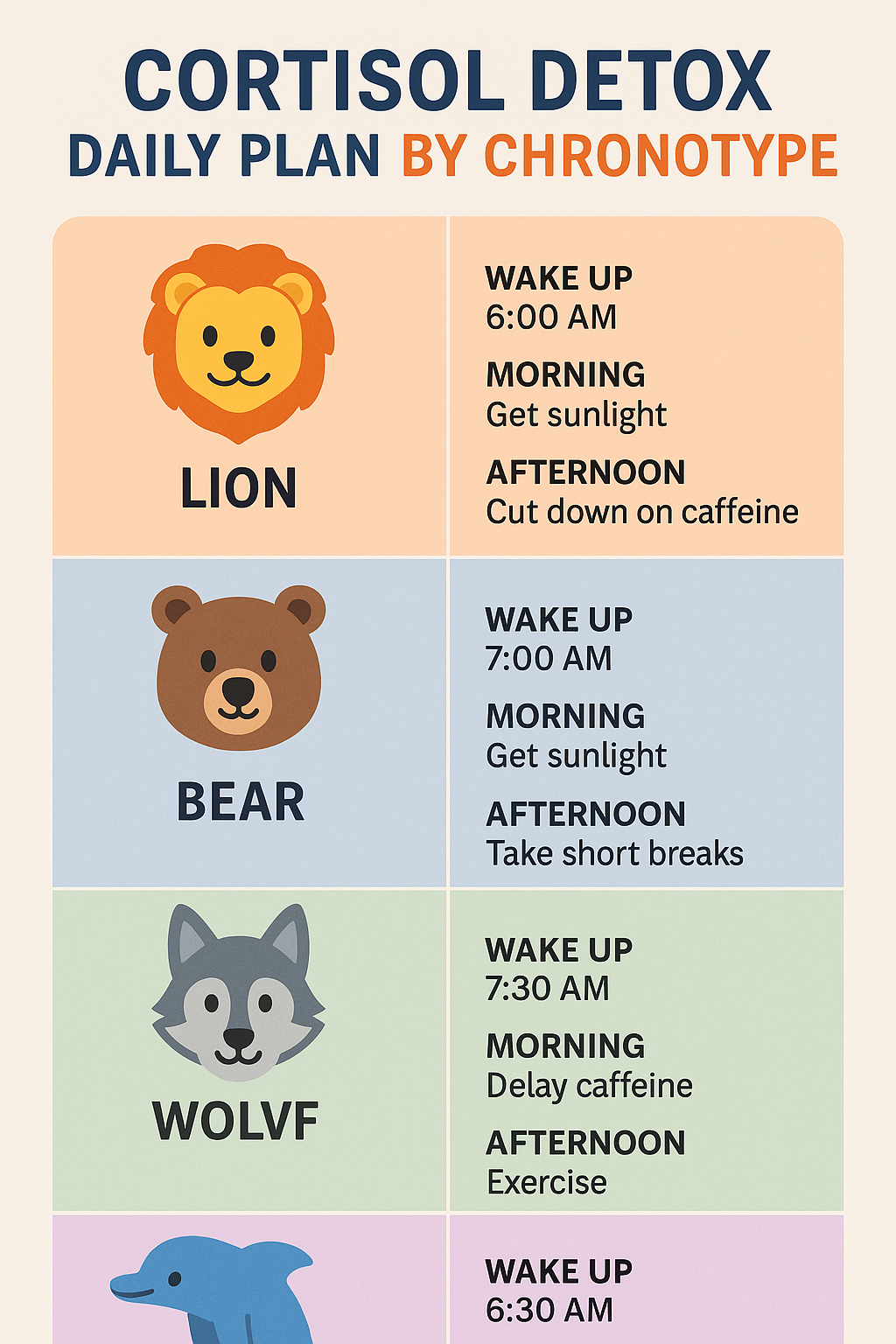
  • Cortisol Detox by Chronotype: A Personalized Approach to Reducing Stress and Boosting Health

    Cortisol Detox by Chronotype: A Personalized Approach to Reducing Stress and Boosting Health

    Have you ever wondered why some people thrive early in the morning while others hit their stride well into the evening? This isn’t just about personal preference—it’s rooted in your chronotype, your body’s natural sleep-wake rhythm. Understanding your chronotype can transform your energy levels, stress response, and overall health when paired with cortisol management. This blog explores how a cortisol detox tailored to your chronotype can help you feel balanced and recharged.

    Read Also: Early Signs of Iron Deficiency in Women: Symptoms, Causes, and What You Need to Know

    Cortisol detox by chronotype

    What Is Cortisol and Why Does It Matter?

    Cortisol is often dubbed the “stress hormone.” It plays a vital role in regulating your metabolism, blood pressure, and immune system—and most importantly, it helps you respond to stress. Naturally, cortisol peaks in the early morning to help you wake up and slowly declines throughout the day.

    However, chronic stress, poor sleep, and irregular habits can throw this natural rhythm off balance, leading to issues like:

    • Fatigue
    • Weight gain
    • Insomnia
    • Mood swings
    • Weakened immunity

    A cortisol detox isn’t about flushing the hormone out of your system (your body needs it). It’s about restoring balance and preventing chronic overstimulation by aligning your habits with your body’s chronobiology—your unique circadian rhythm.

    What Is a Chronotype?

    Your chronotype determines when your body naturally wants to sleep, eat, and be active. According to sleep specialist Dr. Michael Breus, there are four primary chronotypes:

    1. Lion – Early risers, peak productivity in the morning, and fade by evening.
    2. Bear – The most common type, aligned with the sun. Energy peaks mid-morning to early afternoon.
    3. Wolf – Night owls. Struggle in the morning, but energised late afternoon and evening.
    4. Dolphin – Light sleepers with irregular patterns. Often anxious and hyper-aware.

    Understanding your chronotype allows you to time key activities like caffeine intake, exercise, and wind-down rituals to better support healthy cortisol cycles.

    Read Also: How Cutting Out Sugar Speeds Up Weight Loss: The Science, Benefits, and Sustainable Tips for Beginners

    Cortisol Detox Strategies by Chronotype

    🦁 Lions (Early Risers)

    • Cortisol Peak: Early morning
    • Challenge: Energy crashes in the afternoon
    • Detox Tips:
      • Engage in light morning workouts (e.g., walking or yoga)
      • Avoid caffeine after 10 a.m.
      • Power nap or relax during afternoon slumps
      • Use calming evening rituals to aid sleep (e.g., herbal tea, journaling)

    🐻 Bears (Solar Synced)

    • Cortisol Peak: Mid-morning
    • Challenge: Energy wanes if the routine is disrupted
    • Detox Tips:
      • Stick to a consistent wake-sleep cycle
      • Take screen breaks throughout the day to avoid overstimulation
      • Avoid late meals or alcohol before bed
      • Practice mindfulness during lunch or short walks in nature

    🐺 Wolves (Night Owls)

    • Cortisol Peak: Late afternoon or evening
    • Challenge: Groggy mornings, alert late at night
    • Detox Tips:
      • Delay caffeine until at least 10 a.m.
      • Use a sunrise alarm to wake gradually
      • Schedule workouts in the evening
      • Avoid doomscrolling late at night—use blue light blockers

    🐬 Dolphins (Light Sleepers)

    • Cortisol Pattern: Irregular, often triggered by anxiety
    • Challenge: Poor sleep quality, overthinking
    • Detox Tips:
      • Follow strict sleep hygiene (no screens 1 hour before bed)
      • Try meditation or progressive muscle relaxation at night
      • Limit stimulants like sugar and caffeine
      • Use a weighted blanket or calming music to reduce anxiety

    Universal Cortisol Detox Habits (Good for All Chronotypes)

    Regardless of your chronotype, these strategies can support healthy cortisol levels:

    Read Also: Clear Nasal Congestion with Bay Leaves: The Power of Bay Leaves

    • Get early sunlight exposure – Signals your body to regulate cortisol naturally
    • Eat a balanced breakfast – With protein and healthy fats to stabilize blood sugar
    • Limit sugar and processed foods – Reduce cortisol spikes
    • Exercise daily – Choose the right time based on your chronotype
    • Prioritize restorative sleep – Stick to a regular schedule
    • Practice stress-reducing activities – Meditation, deep breathing, or nature walks

    Final Thoughts: Honour Your Rhythm, Heal Your Stress

    You don’t need a one-size-fits-all routine to manage stress. Instead, aligning your daily habits with your chronotype helps you work with your body, not against it. By doing so, your cortisol levels naturally stabilise, leading to better sleep, less anxiety, and a more productive day.

    So, whether you’re a lion rising with the sun or a wolf who thrives under moonlight, your cortisol detox starts with knowing your rhythm.