Category: Lifestyle

Fashion โ€ข Beauty โ€ข Self-improvement โ€ข Education , Lifestyle

  • Stop Drifting : Do a Life Audit Before Life Audits You

    Stop Drifting : Do a Life Audit Before Life Audits You

    Have you ever felt like youโ€™re moving, but not really going anywhere? You wake up, rush through the motions, and go to bed wondering where the day or even the year went. You tell yourself things will change โ€œsoon,โ€ but somehow, soon never comes.

    If that sounds familiar, then this is your wake-up call.

    Itโ€™s time to do a life audit.

    This isnโ€™t about creating a wish list of dreams or another set of resolutions youโ€™ll forget by February. Doing a life audit is about pausing long enough to understand where you truly are, whatโ€™s working, whatโ€™s draining you, and what needs to change now.

    Because hereโ€™s the truth: if you donโ€™t do a life audit, life will do one for you.
    And trust me lifeโ€™s version usually comes in the form of burnout, regret, or a crisis that forces you to stop.

    What Does It Mean to Do a Life Audit?

    A life audit is like a financial audit, but for your soul.
    Itโ€™s an honest check-in with yourself across the 8 key areas that shape your happiness, fulfillment, and growth:

    1. Health
    2. Finances
    3. Personal development
    4. Career
    5. Relationships
    6. Self-care
    7. Home
    8. Free time

    When you do a life audit, youโ€™re asking:

    โ€œWhere am I right now, and what needs to change for me to live better?โ€

    Simple question. Transformative answers.

    Letโ€™s unpack each area because your best life starts where honesty meets action.

    1. Health โ€“ The Foundation of Everything

    Without your health, nothing else stands. Yet itโ€™s often the first thing we neglect.
    Ask yourself:

    • How do I feel when I wake up in the morning?
    • Am I eating to nourish or just to survive?
    • Do I move my body enough?
    • When was the last time I felt truly energetic?

    Start small. Drink more water. Sleep one extra hour. Replace scrolling time with stretching time. When you do a life audit, youโ€™ll realize that your body keeps the score and itโ€™s time to rewrite the script.

    2. Finances โ€“ The Mirror of Your Habits

    Money doesnโ€™t buy happiness, but financial stress can steal it.
    Be brutally honest here. Are you managing your money, or is your money managing you?

    List your expenses, track your debts, and face your numbers without fear. Then, shift your mindset from spending to building. Create a savings plan, start that side hustle, or invest in a skill that earns you more tomorrow.

    Doing a life audit in your finances means regaining control and choosing peace over panic.

    3. Personal Development โ€“ Grow or Stay Stuck

    When was the last time you learned something new just for yourself?

    Growth doesnโ€™t stop when school ends. It stops when curiosity dies.
    Read. Listen to podcasts. Take online courses. Learn a new language or skill. Reflect on your strengths and weaknesses.

    If you do a life audit today, you might realize that youโ€™ve been running on autopilot reacting to life instead of intentionally creating it.
    Your mind needs feeding, too. Donโ€™t starve it.

    4. Career โ€“ Alignment Over Achievement

    So many people chase promotions, titles, or bigger salaries but still feel empty.
    Ask yourself:

    • Am I proud of what I do every day?
    • Does my work align with my values?
    • Do I see a future where Iโ€™m growing, not just grinding?

    If the answer is โ€œno,โ€ itโ€™s time to realign. Maybe itโ€™s a career shift, maybe itโ€™s setting boundaries, or maybe itโ€™s starting your own thing.
    You spend most of your waking hours at work make sure it feeds your purpose, not just your bills.

    5. Relationships โ€“ Who You Keep Around You Shapes You

    Your circle can either lift you or drain you.
    When you do a life audit, assess your relationships honestly:
    Who supports your growth? Who only calls when they need something? Who makes you feel seen and valued?

    Distance doesnโ€™t mean hate it means peace. Surround yourself with people who challenge you to be better, not bitter.
    And if love feels complicated, start by loving yourself first. The rest will follow.

    6. Self-Care โ€“ Not Luxury, But Maintenance

    Self-care isnโ€™t bubble baths and candles (though those help). Itโ€™s setting boundaries, saying no, and resting when you need to.
    Itโ€™s taking care of your mind, body, and emotions before they collapse.

    When you do a life audit, check if youโ€™re constantly pouring from an empty cup.
    Remember: You canโ€™t show up for others if youโ€™re constantly neglecting yourself.

    7. Home โ€“ Your Environment Reflects Your Energy

    Look around. Is your space inspiring or draining you?
    Clutter in your environment often mirrors clutter in your mind.

    Clean one corner. Organize your workspace. Add something that brings you joy, maybe a plant, a scent, or even sunlight.
    Doing a life audit means making your environment match the life youโ€™re trying to build.

    Your home should be a place of peace, not pressure.

    8. Free Time โ€“ The True Test of Fulfillment

    What do you do when no oneโ€™s watching and you have nowhere to be?

    Many people realize during a life audit that they donโ€™t really have free time they just have time filled with distractions.

    Do something that recharges you not numbs you. Paint, cycle, read, explore, meditate, or volunteer.
    Your free time is where your real self emerges. Protect it.

    How to Start Your Life Audit Today

    Getting started doesnโ€™t have to be overwhelming. The key is honesty and intention โ€” not perfection. Hereโ€™s how to do a life audit in a practical, powerful way:

    1. Rate Each Area (1โ€“10): Be Brutally Honest

    Grab a notebook or open a digital journal and list the 8 key areas:
    Health, Finances, Personal Development, Career, Relationships, Self-Care, Home, and Free Time.

    Now, rate each one on a scale of 1 to 10, where:

    • 1 = โ€œThis area is draining me or feels completely off track.โ€
    • 10 = โ€œIโ€™m genuinely proud and fulfilled here.โ€

    Donโ€™t overthink your score โ€” go with your gut.
    The goal isnโ€™t to judge yourself, but to see where the imbalance lies. Most people find that 2โ€“3 areas dominate their focus while others are neglected. Thatโ€™s your first clue to what needs attention.

    Tip: Visual learners can create a โ€œLife Wheelโ€ โ€” draw a circle, divide it into 8 sections, and shade each area up to your rating. The uneven parts show where growth is needed.

    2. Write Whatโ€™s Working and Whatโ€™s Not: Awareness Is Power

    Once youโ€™ve rated each area, reflect deeper:

    • Whatโ€™s going right in this area?
    • Whatโ€™s not working โ€” and why?
    • What emotions come up when you think about this part of your life?

    For example:
    If your career rates a 4, maybe youโ€™re good at your job but feel stuck or underappreciated. If relationships are a 6, maybe you have good friends but lack deeper emotional connections.

    Writing these truths out is uncomfortable, but necessary. Awareness is the first step to change. You canโ€™t fix what you refuse to face.

    Journal Prompt:

    โ€œIf nothing changed in this area for the next year, how would that make me feel?โ€

    Your answer will tell you where to focus your energy first.

    3. Identify One Small Action Per Area: Tiny Steps, Massive Shifts

    Hereโ€™s where most people go wrong โ€” they try to overhaul everything at once.
    But transformation doesnโ€™t happen from grand gestures; itโ€™s built on consistent, small actions that compound over time.

    Ask yourself:

    โ€œWhatโ€™s one realistic thing I can do this week to improve this area โ€” even slightly?โ€

    Examples:

    • Health: Walk 30 minutes every morning or drink 2L of water daily.
    • Finances: Cancel unused subscriptions or set up an automatic savings transfer.
    • Career: Update your resume or enroll in a short course.
    • Relationships: Call a friend you havenโ€™t spoken to in months.
    • Self-care: Set a digital boundary โ€” no screens after 10 p.m.
    • Home: Declutter one drawer or shelf each day.
    • Free time: Dedicate one hour a week to something creative or joyful.

    Remember, progress happens when small steps become habits.
    By doing one meaningful thing per area, youโ€™re creating a ripple effect that transforms your entire life.

    4. Revisit Every 3 Months: Progress Is a Journey, Not a One-Time Event

    Life changes โ€” and so will your priorities. Thatโ€™s why a life audit isnโ€™t a one-and-done task; itโ€™s an ongoing practice of reflection and realignment.

    Every three months, sit down and repeat the process.
    Ask:

    • What improved since my last audit?
    • What still feels out of balance?
    • What new goals or values have emerged?

    Celebrate your progress โ€” no matter how small. If youโ€™ve gone from a 4 to a 6 in any area, thatโ€™s real growth.

    Consistency builds clarity. Clarity builds confidence.
    And confidence builds a life that feels aligned โ€” not accidental.

    Bonus Tip: Create a โ€œLife Audit Vision Pageโ€

    To keep your goals visible, create a one-page summary that lists:

    • Your scores for each area
    • Your top priorities
    • The one small action youโ€™re committed to
    • A quote or affirmation that inspires you

    Place it somewhere youโ€™ll see it daily โ€” your journal, mirror, or phone wallpaper.
    Itโ€™s your personal reminder that youโ€™re not stuck; youโ€™re evolving.

    When you do a life audit intentionally, it stops being a task โ€” and becomes a turning point.
    You start seeing your life not as chaos to survive, but as a system you can design and direct.

    Even 20 minutes of reflection can save you years of confusion.

    The Power of Doing a Life Audit

    When you do a life audit, something magical happens:
    You stop living reactively and start living intentionally.

    You begin to see patterns the habits that drain you, the routines that anchor you, and the dreams that still matter.
    You stop blaming luck or timing and start designing your own transformation.

    Remember, no oneโ€™s life is perfect. But those who evolve continuously take time to pause, reflect, and redirect.

    You canโ€™t change what you donโ€™t acknowledge.

    So take that pen, open that notebook, and begin your audit.
    Not tomorrow. Not next week. Today.

    Because every day you delay is one more day you live someone elseโ€™s version of your life instead of your own.

    Final Thought

    If youโ€™ve been waiting for a sign, this is it.
    Do a life audit before life audits you.

    Donโ€™t wait for burnout, heartbreak, or failure to make you stop and rethink.
    You deserve clarity, purpose, and peace and the first step is reflection.

    Your next chapter starts with one question:

    โ€œWhat changes would make the biggest impact in my life right now?โ€

    Answer that, and your life will never look the same again.

  • The Hard Truths Every Man Must Face to Build Himself Up

    The Hard Truths Every Man Must Face to Build Himself Up

    This is the Hard Truth Every Man Must Face to Build Himself. At some point, every man comes face-to-face with an uncomfortable truth: no one is coming to save you. Your life, your peace, and your progress are entirely your responsibility. No oneโ€™s going to hand you success or rescue you from struggle and thatโ€™s not meant to discourage you. Itโ€™s meant to wake you up.

    Because once you stop expecting help and start taking charge, everything changes.

    1. A Man Without Money Has No Voice

    Hard Truths Every Man Must Face to Build Himself Up

    You can have the biggest dreams and the kindest heart, but if your finances are in chaos, youโ€™ll struggle to be heard. Money doesnโ€™t buy happiness, but it does buy options which are freedom, stability, and the power to walk away from disrespect.

    Before you try to fix the world, fix your wallet.
    Learn how to budget, save, and build something that gives you peace of mind. When you handle your finances, you handle your future.

    Read Also:Whatโ€™s Your True Temperament? Take This Quick Self-Test to Find Out!

    2. Going Through Hard Times Alone Builds You

    Thereโ€™s a silent power in surviving your darkest days alone.
    When no one checks in, when you face pain in silence thatโ€™s when you find your real strength.

    Once youโ€™ve gone through your worst time alone, you stop chasing peopleโ€™s approval. You realize you donโ€™t need everyone just a few real ones.

    Solitude isnโ€™t punishment. Itโ€™s where you grow, rebuild, and become someone no storm can break.

    Read Also: Relieve Itchy Skin After Shower Naturally: Proven Remedies That Actually Work

    3. Fitness Is More Than Looks, Itโ€™s Discipline

    Hard Truths Every Man Must Face to Build Himself Up

    Hereโ€™s an uncomfortable truth: people respect you more when youโ€™re in good shape.

    Itโ€™s not about vanity itโ€™s about what your body says about your mindset. A man whoโ€™s disciplined enough to stay fit sends a message: I take care of myself.

    Go for morning runs, hit the gym, or do bodyweight workouts at home just stay consistent. Fitness builds confidence, focus, and self-respect.

    ๐Ÿ’ช Tip: Start small. 20 minutes a day can transform your mindset and energy levels.

    4. Look Sharp, Smell Good, Speak Calmly

    Respect often begins with presentation.

    Keep a clean haircut. Dress well not necessarily expensive, but intentional. Smell good. Talk slower. Smile when it matters.

    You donโ€™t need to prove yourself loudly your presence should speak before you even open your mouth. When you look and carry yourself like a man who respects himself, people naturally respect you too.

    5. Accept the Loneliness, Then Fix Your Life

    Being a man sometimes means walking alone. But solitude doesnโ€™t have to feel like isolation itโ€™s the space where clarity lives.

    Be private. Move in silence. Build your life quietly. Accept that the path to becoming your best self often looks lonely, but the results will be worth it.

    No one is coming to save you. Your life is 100% your responsibility.

    Read Also: Your Body Is Begging for a Digital Detox: How it can Change Your Life.

    Become the Man Youโ€™d Look Up To

    Being a man isnโ€™t about perfection itโ€™s about progress.
    Itโ€™s about owning your flaws, fixing your weaknesses, and showing up every single day even when no oneโ€™s watching.

    Fix your finances. Strengthen your body. Protect your peace.
    Because at the end of the day, the world respects the man who respects himself.

  • Whatโ€™s Your True Temperament? Take This Quick Self-Test to Find Out!

    Whatโ€™s Your True Temperament? Take This Quick Self-Test to Find Out!

    Have you ever wondered why some people are naturally energetic while others remain calm no matter the situation? Or why certain friends thrive in leadership roles while others prefer deep reflection? The answer might lie in something ancient yet surprisingly accurate: the four temperaments. These personality blueprints, first described by Hippocrates and later echoed in biblical interpretations, still shape how we understand human behavior today. [TAKE THE TEMPERAMENT TEST BELOW.]

    Imagine unlocking the code to your own personalityโ€”knowing why you react to stress the way you do, what drives your motivation, and even how you connect with others. Thatโ€™s the power of understanding temperaments. Whether youโ€™re an extrovert who loves to be the life of the party or an introvert who thrives in peaceful settings, your temperament reveals the โ€œwhyโ€ behind your habits and choices.

    And hereโ€™s the best part: once you know your temperament, you can use that knowledge to strengthen relationships, manage emotions, and grow into the best version of yourself. So letโ€™s dive into the fascinating world of temperaments and answer the big questions people often ask.

    What Are the 4 Types of Temperament?

    Traditionally, human personalities are grouped into four core temperaments:

    1. Sanguine โ€“ Lively, enthusiastic, and sociable. Sanguines love people, fun, and adventure.
    2. Choleric โ€“ Strong-willed, goal-driven, and natural leaders. Cholerics thrive on challenges and action.
    3. Melancholic โ€“ Thoughtful, analytical, and detail-oriented. Melancholics are deep thinkers with a sensitive nature.
    4. Phlegmatic โ€“ Calm, patient, and dependable. Phlegmatics value harmony and are natural peacemakers.

    Each temperament has its strengths and weaknesses, and most people are a blend of two or more.

    How Do I Know My Temperament Type?

    You can identify your temperament by observing your natural tendencies:

    • If you love being around people, get excited easily, and often act on impulseโ€”you may be sanguine.
    • If youโ€™re ambitious, decisive, and dislike being controlledโ€”youโ€™re likely choleric.
    • If you prefer routines, think deeply before acting, and notice details others missโ€”you may be melancholic.
    • If you remain calm under pressure, avoid conflict, and prefer stabilityโ€”you may be phlegmatic.

    Many people also take a temperament test or personality quiz to confirm their type. These tests highlight your dominant traits and help you see how they play out in everyday life.

    This is just a test and cannot be used as definitive reflection of your temperament

    Self-Personalized Quiz

    Find Your Temperament: 12-Question Quick Test

    Rate how true each statement is for you. Your results will reveal your dominant temperament and your blend.

    0 / 12 answered
    โ€ŽFollow the InfoHealthGh channel on WhatsApp: https://whatsapp.com/channel/0029Va7j1SgGE56e8pagc22u

    Read Also: Feeling Burnt Out? Take This Work-Related Stress Test

    How the Different Temperaments Relate to Each Other

    One of the coolest things about temperaments is seeing how they mix and match in real life. Friendships, marriages, or even work partnerships often work (or clash) because of these personality combos. Letโ€™s break it down in a way that actually makes sense in everyday life.

    Sanguine + Choleric

    This duo is like fireworksโ€”exciting, loud, and full of energy. The Sanguine brings the fun, while the Choleric brings the drive. Together, they can make things happen fast. The flip side? The Choleric might think the Sanguine is too โ€œall over the place,โ€ and the Sanguine might feel bossed around. But when they learn to respect each other, theyโ€™re unstoppable.

    Sanguine + Melancholic

    Talk about opposites attracting. The Sanguine is the โ€œletโ€™s go have funโ€ type, while the Melancholic is more of a โ€œletโ€™s think this throughโ€ kind of person. It actually balances out nicelyโ€”one adds excitement, the other adds depth. The challenge? Sanguine might see Melancholic as too serious, while Melancholic might think Sanguine never slows down. Still, it works when both appreciate what the other brings to the table.

    Sanguine + Phlegmatic

    This is a pretty chill combo. The Sanguineโ€™s energy keeps life interesting, while the Phlegmaticโ€™s calm nature keeps everything from spiraling out of control. They both love people and get along easily. Their weak spot? Neither loves making tough decisions, so things can drag when action is needed.

    Choleric + Melancholic

    These two are all about getting things done. The Choleric is the bold leader charging ahead, and the Melancholic is the detail-oriented planner making sure nothing falls apart. Together, theyโ€™re a powerhouse. Butโ€ฆ the Cholericโ€™s โ€œletโ€™s go nowโ€ can clash with the Melancholicโ€™s โ€œwait, letโ€™s double-check.โ€ If they find the middle ground, they can conquer just about anything.

    Choleric + Phlegmatic

    This pair is a classic balance. The Choleric brings fire and passion, while the Phlegmatic brings calm and peace. It works because one pushes forward and the other slows things down just enough. The tricky part? The Choleric might get frustrated that the Phlegmatic isnโ€™t more assertive, while the Phlegmatic might feel steamrolled. Communication is key here.

    Melancholic + Phlegmatic

    This is the gentle, thoughtful combo. Both are steady, loyal, and prefer calm over chaos. The Melancholic brings ideas and standards, while the Phlegmatic brings patience and stability. Their downside? They can both be too passive, avoiding confrontation even when itโ€™s needed. But if they learn to speak up, this is one of the most peaceful pairings around.

    ๐Ÿ‘‰ Bottom line: No temperament combo is โ€œperfectโ€ or โ€œterrible.โ€ Every mix has strengths and struggles. What makes relationships thrive is understanding each other and learning how to work withโ€”not againstโ€”your differences.

    Check Your BMI Here : InfohealthGH BMI Calculator

    What Are the 4 Temperaments in the Bible?

    The Bible doesnโ€™t explicitly list the four temperaments, but Christian thinkers through history have connected them with biblical characters and teachings and they are as follows:

    • Sanguine (Peter) โ€“ Outspoken, passionate, and quick to act.
    • Choleric (Paul) โ€“ Bold, determined, and strong leader.
    • Melancholic (Moses) โ€“ Deep, thoughtful, sometimes burdened with responsibility.
    • Phlegmatic (Abraham) โ€“ Patient, steady, and faithful.

    These connections show how temperaments reflect both strengths and struggles, reminding believers that God works through all personality types for His purpose.

    โœ… Takeaway: Whether you view them through psychology or scripture, temperaments offer timeless insight into who you are and how you relate to the world. Knowing yours is the first step to self-awareness, personal growth, and stronger relationships.

  • Feeling Burnt Out? Take This Work-Related Stress Test

    Feeling Burnt Out? Take This Work-Related Stress Test

    The beginning of the month is here, you’re done with paying your bills from the previous month and have switched to full survival mode. Perhaps the thinking, tight schedule, and approaching deadlines are adding to your stress levels, and you don’t know what is happening. Well, in this blog post, we are going to discover through a simple test to try and quantify your work-related stress.

    Work-Related Stress Test
    Ways to Manage Stress

    From minimal work-related stress to severe work-related stress, the scoring system of this test seeks to only educate on your stress level and not to substitute an actual evaluation.

    This work-related stress test is designed to help you assess the amount of pressure you’re experiencing at work and whether itโ€™s taking a toll on your well-being. Stress is a normal part of life, but when it becomes chronic or overwhelming, itโ€™s time to take some action.

    ๐Ÿง  Note: This test is for educational purposes only. If you’re experiencing serious symptoms, speak to a mental health professional.

    Read Also: What happens if you eat onions every day?

    ๐Ÿงช Work-Related Stress Self-Test

    Instructions: For each statement below, rate how often you’ve felt this way in the past 30 days.

    Scale:

    • 0 โ€“ Never
    • 1 โ€“ Rarely
    • 2 โ€“ Sometimes
    • 3 โ€“ Often
    • 4 โ€“ Always

    Work-Related Stress Test

    This tool is for educational purposes only. If you’re struggling, please talk to a professional.


    1. I feel exhausted at the end of the workday.

    Do you often leave work physically or mentally drained?


    2. I have trouble sleeping because Iโ€™m thinking about work.

    Does work-related anxiety keep you up at night?


    3. I feel overwhelmed by the number of tasks I have to do.

    Do your daily duties feel unmanageable?


    4. I find it hard to concentrate or stay focused while working.

    Are you easily distracted or mentally checked out at work?


    5. I feel underappreciated or undervalued at work.

    Do you feel like your efforts go unnoticed or unrewarded?


    6. I have frequent headaches, stomach issues, or muscle tension.

    Are physical symptoms like tension or pain becoming common?


    7. I feel irritable, anxious, or moody due to work stress.

    Is your job affecting your emotions or how you treat others?


    8. I avoid or dread going to work.

    Do you feel a pit in your stomach just thinking about Monday?


    9. I find it difficult to enjoy time off because Iโ€™m thinking about work.

    Is your stress following you into evenings or weekends?


    10. I feel like I canโ€™t talk to anyone at work about how Iโ€™m feeling.

    Do you feel isolated, unsupported, or afraid to speak up?


    Read Also: Relieve Lower Back Pain with these simple remedies

    โœ… How to Score Your Results

    For each question, assign points based on your answers:

    • Never = 0 points
    • Rarely = 1 point
    • Sometimes = 2 points
    • Often = 3 points
    • Always = 4 points

    Maximum Score: 40
    Minimum Score: 0
    Now add up your total score.

    ๐Ÿ“Š Stress Level Interpretation

    Total ScoreStress Level
    0โ€“10Minimal work-related stress
    11โ€“20Mild stress โ€” manageable
    21โ€“30Moderate stress โ€” watch closely
    31โ€“40Severe work-related stress โ€” act now

    ๐Ÿง  What Your Results Mean

    โœ… 0โ€“10: Minimal Stress

    Youโ€™re handling your workload well and maintaining a good work-life balance. Keep up the healthy habits.

    โš ๏ธ 11โ€“20: Mild Stress

    You’re under some pressure, but it’s still manageable. Nowโ€™s a great time to focus on self-care and boundaries.

    ๐ŸŸก 21โ€“30: Moderate Stress

    Stress is starting to interfere with your well-being. Consider speaking to a supervisor, adjusting your workload, or getting support from HR or a counsellor.

    ๐Ÿ”ด 31โ€“40: Severe Stress

    You may be experiencing burnout or chronic work-related anxiety. This is a clear sign to take actionโ€”seek help, take a break, or speak to a mental health expert.

    ๐Ÿ’ผ Why This Work-Related Stress Test Matters

    Unchecked stress can lead to serious issuesโ€”chronic fatigue, depression, weakened immunity, and even heart problems. Taking a work-related stress test like this regularly can help you stay aware and proactive about your mental health.

    ๐Ÿ—ฃ๏ธ Talk About It

    Open conversations about stress at work can reduce stigma and build a healthier culture. If you’re a manager, encourage your team to check in with themselves, too.

    ๐Ÿง˜โ€โ™€๏ธ Practical Tips:

    • Take real lunch breaks away from your desk
    • Use your leave days without guilt
    • Practice mindfulness or deep breathing
    • Delegate when possible
    • Speak to someoneโ€”friend, therapist, or coach

    Work is part of lifeโ€”but it shouldnโ€™t cost your mental or physical health. If this work-related stress test revealed high levels of stress, don’t ignore it. Help is available, and taking small steps now can prevent bigger issues later.

    ๐Ÿ“Œ Save this test, share it with a coworker, or revisit it monthly to stay in tune with your stress levels.

    Read Also: Seven (7) things they wonโ€™t tell you about growing up

  • Relieve Itchy Skin After Shower Naturally: Proven Remedies That Actually Work

    Relieve Itchy Skin After Shower Naturally: Proven Remedies That Actually Work

    Experiencing an itchy skin after bathing is something that is becoming pretty common these days and almost everyone, I have spoken to has experienced this before or still living with this nightmare. Let’s talk about ways to relieve itchy skin after shower naturally and additional tips to solve or make the situation better.

    Taking a shower these days is gradually becoming a fear you have to live with. If this is your situation then you are not alone. I have personally experienced this before and almost everything I tried on the internet didn’t work or even made matters worse. Some friends even suggested checking my water because the water distribution systems in Ghana isn’t always the best.

    Relieve itchy skin after shower naturally

    Many grown-ups also experience post-shower itchiness, and the solution isn’t always more lotion. In this guide, weโ€™ll walk through why it happens, how to relieve itchy skin after shower naturally, and what habits you can adopt for long-term comfort.

    Read Also: Your Skin Reflects Your Health: What Acne, Dryness, and Discoloration Could Mean

    As a trusted voice on health and wellness, weโ€™ve gathered expert-backed insights, peer-reviewed tips, and practical natural remedies that actually work โ€” even in warm climates like Ghana where dryness and sweat can make skin irritation worse.

    ๐Ÿง Why Does Your Skin Itch After a Shower?

    Before we dive into natural solutions, itโ€™s important to understand the โ€œwhy.โ€ Here are some common culprits:

    • Hot Water: Strips your skin of its natural oils.
    • Harsh Soaps & Body Washes: Contain chemicals that can dry out or irritate your skin.
    • Hard Water Minerals: Excess calcium or magnesium in tap water can lead to irritation.
    • Towel Rubbing: Rough towels or excessive rubbing can damage sensitive skin.
    • Underlying Skin Conditions: Eczema, dermatitis, or aquagenic pruritus may be triggered by water exposure.

    ๐ŸŒฟ How to Relieve Itchy Skin After Shower Naturally

    Ready to ditch the discomfort? Here are tried-and-tested remedies and preventative tips.

    1. Switch to Lukewarm Water

    Why it matters: Hot water might feel soothing, but itโ€™s harsh on your skin. It strips away the skinโ€™s natural oils that act as a protective barrier. When those oils are gone, your skin dries out quickly, triggering that tight, itchy feeling right after bathing. Over time, this can even lead to chronic dryness or inflammation.

    What to do instead: Aim for lukewarmโ€”not coldโ€”water. Itโ€™s warm enough to relax you but gentle enough to keep your skinโ€™s moisture intact. Especially in warmer climates like Ghana, your skin already faces extra dryness from sun exposure and air conditioning, so lukewarm showers help balance hydration.

    Retinol and Tretoin Use โ€“ Your excessive skincare routine jeopardize your Pregnancy

    2. Oatmeal Rinse or Bath

    Relieve itchy skin after shower naturally

    Why it works: Colloidal oatmeal (finely ground oatmeal suspended in liquid) is a natural anti-inflammatory. It contains compounds like avenanthramides and beta-glucans that soothe skin irritation, reduce itching, and help skin retain moisture. Research shows that oatmeal is effective for conditions like eczema, dry skin, and post-shower irritation.

    How to use it:

    • Mix 1 cup of colloidal oatmeal in a warm bath and soak for 10โ€“15 minutes.
    • Alternatively, brew oatmeal water and pour it over your skin before your final rinse.

    Itโ€™s gentle, affordable, and safe for all skin typesโ€”especially helpful for sensitive or reactive skin that flares up after bathing.

    3. Use a Natural Moisturizer Immediately

    Apply within 2 minutes of leaving the shower:

    • Coconut oil (anti-inflammatory and hydrating)
    • Shea butter (rich in fatty acids and antioxidants)
    • Aloe vera gel (cooling and healing)

    Make sure your moisturizer is fragrance-free and natural. Synthetic scents often worsen irritation.

    โ€ŽFollow the InfoHealthGh channel on WhatsApp: https://whatsapp.com/channel/0029Va7j1SgGE56e8pagc22u

    4. Try Apple Cider Vinegar Spray

    Dilute 1 tablespoon of ACV in 1 cup of water and spritz lightly after your shower. It restores pH balance and can help reduce bacterial inflammation.

    5. Pat Dry with a Soft Cotton Towel

    Avoid aggressive rubbing. Dab your skin gently to remove moisture while preserving your skinโ€™s barrier.

    โœ… Preventive Skincare Tips That Help Long-Term

    To keep itchy skin away, consistency is key.

    • Gentle Soap Choices: Opt for castile soap or those labeled โ€œfor sensitive skin.โ€
    • Moisturize Twice Daily: Once after showering and once before bed.
    • Stay Hydrated: Drink water consistentlyโ€”your skin needs it from the inside out.
    • Humidify Your Space: If indoor air is dry, use a bowl of water near your bed or a humidifier.
    • Monitor Your Diet: Omega-3-rich foods like flaxseeds, salmon, and avocados help nourish skin.

    Updated From : Six Reasons Why Your Body Itches After Bathing (And How to Stop It)

  • 10 Natural Ways to Sleep Better at Night (Without Pills or Melatonin)

    10 Natural Ways to Sleep Better at Night (Without Pills or Melatonin)

    If you struggle to fall asleep at night then this post is for you, keep in mind that you are not alone in this struggle. There are millions of people who find it difficult to wind down after long, stressful daysโ€”and instead of reaching for a sleeping tablets, many are now turning to more natural, sustainable approaches.

    The good news is that you can improve your sleep without medication. These 10 natural ways to sleep better at night are backed by research and recommended by sleep experts. Letโ€™s explore how small, intentional changes can lead to deep, restorative sleepโ€”naturally.

    ๐Ÿ•’ 1. Stick to a Consistent Sleep Schedule

    10 Natural Ways to Sleep Better at Night

    Your body has a built-in internal clock known as the circadian rhythm, which helps regulate your sleep-wake cycle. When you go to bed and wake up at the same time every day, youโ€™re reinforcing this natural rhythmโ€”making it easier to fall asleep at night and wake up feeling refreshed.

    Inconsistent sleep patterns, like staying up late on weekends or constantly shifting bedtimes, can confuse this rhythm. Research shows that people who stick to a regular sleep schedule experience deeper, higher-quality sleep. So even if itโ€™s tempting to sleep in on Sunday, aim to keep your wake-up time within the same 30โ€“60 minute window every day.

    โ€ŽFollow the InfoHealthGh channel on WhatsApp: https://whatsapp.com/channel/0029Va7j1SgGE56e8pagc22u

    ๐Ÿ›๏ธ 2. Create a Sleep-Friendly Environment

    The environment you sleep in has a significant impact on how easily you drift offโ€”and how soundly you stay asleep. A dark, quiet, and cool room helps your brain associate the space with rest. It also signals your body to release melatonin, the hormone responsible for making you feel sleepy.

    Experts recommend setting your room temperature between 60โ€“67ยฐF (16โ€“19ยฐC). Blackout curtains, white noise machines, and clutter-free spaces can all help turn your bedroom into a true rest zone. Your bed should also feel comfortable and supportiveโ€”if your mattress or pillows are more than 7 years old, it might be time for an upgrade.

    ๐Ÿ“ฑ 3. Limit Screen Time and Blue Light Exposure

    10 Natural Ways to Sleep Better at Night

    Scrolling through your phone or watching TV late into the night may seem harmless, but the blue light from screens can delay your bodyโ€™s melatonin production. This light tricks your brain into thinking itโ€™s still daytime, which can make it harder to fall asleepโ€”even if you’re physically tired.

    To support your natural sleep cycle, try powering down electronics at least an hour before bed. If you need to wind down with a screen, use blue light filters or night shift settings. You can also switch to offline, relaxing activities like reading a physical book or listening to calm music.

    7 Natural Teas to Help You Sleep Longer and Better at Night

    โ˜• 4. Cut Back on Caffeine and Late-Night Eating

    Caffeine is a powerful stimulant, and it can linger in your system for several hours. Even if you drink coffee in the early afternoon, it may still interfere with your sleep that night. Similarly, eating heavy or spicy meals too close to bedtime can cause discomfort, indigestion, and restless sleep.

    Experts suggest avoiding caffeine after 2 p.m. and finishing your last meal at least two to three hours before going to bed. Choose lighter evening snacks if neededโ€”like bananas, almonds, or herbal teaโ€”that support, rather than sabotage, your sleep.

    ๐Ÿง˜ 5. Try Deep Breathing or Meditation Before Bed

    A busy mind is one of the most common barriers to sleep. If you often find yourself overthinking or replaying your day when your head hits the pillow, calming practices like deep breathing, meditation, or mindfulness can help ease your thoughts and relax your body.

    One popular method is the 4-7-8 breathing technique, where you inhale for 4 seconds, hold for 7, and exhale for 8. This slows your heart rate and triggers the parasympathetic nervous systemโ€”your bodyโ€™s natural “rest and digest” mode. Studies have shown that meditation improves sleep quality and can reduce insomnia symptoms over time.

    ๐Ÿต 6. Sip Herbal Teas and Natural Sleep Aids

    Ginger Lemon & Honey Tea

    Nature has its own gentle sleep remedies. Herbal teas made from chamomile, valerian root, or lavender have calming effects that can help you relax before bed. Unlike melatonin pills or prescription sleep aids, these natural options carry a much lower risk of dependence or side effects.

    Chamomile, for example, contains apigeninโ€”a compound that binds to receptors in your brain and encourages sleepiness. Sipping a warm cup about 30 minutes before bed can signal to your body that it’s time to wind down. Just be mindful of how your body responds, and check with a healthcare provider if you’re on medication or pregnant.

    How Lack of Sleep is Ruining Your Mental Health

    ๐Ÿƒ 7. Get Regular Exercise (But Not Too Late)

    "Bโ†„dze" and the Myth of Delayed Childbirth

    Physical activity is one of the most powerful ways to improve sleep naturally. Exercise reduces stress hormones and increases serotonin, which boosts your mood during the day and promotes better rest at night. It also helps you fall asleep faster and spend more time in deep sleep.

    Aim for at least 30 minutes of moderate aerobic exercise most days of the weekโ€”walking, swimming, cycling, or dancing are all great options. But avoid intense workouts within two hours of bedtime, as this can temporarily spike your heart rate and make it harder to relax.

    โœจ 8. Build a Bedtime Routine to Wind Down

    Establishing a simple, calming pre-sleep routine trains your brain to associate certain actions with rest. This might include dimming the lights, brushing your teeth, taking a warm shower, journaling your thoughts, or doing gentle stretches.

    These rituals cue your body that itโ€™s time to shift gears. By the time youโ€™re in bed, your mind will already be halfway to dreamland. The key is consistencyโ€”when you do the same routine nightly, your brain begins to expect sleep at that time.

    ๐Ÿ’ญ 9. Address Stress and Mental Clutter

    Stress is a major sleep disruptor. If you often lie awake thinking about your to-do list or worrying about the future, managing stress can make a big difference in your sleep quality. Techniques like journaling, practicing gratitude, or writing down a โ€œworry listโ€ before bed can help offload mental clutter.

    Cognitive Behavioral Therapy for Insomnia (CBT-I) is a highly effective method used by sleep specialists to help people break the cycle of racing thoughts and poor sleep. You don’t have to see a therapist to startโ€”there are great CBT-based apps and books that walk you through these techniques.

    Read Also: 10 Interesting Things That Happen to Your Body While Youโ€™re Asleep

    โ˜€๏ธ 10. Get Sunlight in the Morning

    Getting sunlight exposure within the first hour of waking up is one of the most natural and overlooked sleep hacks. Sunlight tells your body itโ€™s time to be awake and sets your internal clock to promote sleep at the right time later in the evening.

    Try stepping outside for a walk, opening your curtains wide, or drinking your morning tea in natural light. Just 15โ€“30 minutes of exposure can help reset your circadian rhythm and support better sleep at night without any supplements or stimulants.

    Conclusion

    Getting quality sleep doesnโ€™t have to come from a bottle. These natural ways to sleep better at night work because they align with your bodyโ€™s own rhythms and responses. By making small changes in your daily habitsโ€”like keeping a consistent schedule, limiting screen time, and creating a calm bedtime routineโ€”you can sleep better, feel more energized, and improve your overall health.

    If you try these tips and still struggle with sleep, donโ€™t ignore it. Consult a sleep specialist to explore underlying causes like anxiety, sleep apnea, or chronic insomnia.

  • Broken Heart Syndrome: Can You Really Die of a Broken Heart?

    Broken Heart Syndrome: Can You Really Die of a Broken Heart?

    They say heartbreak can kill youโ€”but is that literally true? Do you remember the last time you heard a terrible news or had a painful ordeal which was too hard to process or cope? What if i told you inched closer to a broken heart syndrome?

    Broken Heart Syndrome (aka takotsubo or stress cardiomyopathy) transforms emotional pain into shocking physical danger. This article cuts through the fluff, peeling back what science really saysโ€”and how to deal if it happens to you (or someone you love).

    What is Broken Heart Syndrome?

    Broken heart syndrome

    At its core, Broken Heart Syndrome is a temporary weakening of the left side of your heart triggered by intense emotional or physical stress. Imagine grief, a breakup, or even something โ€œgoodโ€ like surprise newsโ€”but your body reacts like it’s under attack. Stress hormones flood your system, โ€œstunningโ€ the heart muscle and making it balloon in that classic octopus-trap shape described by Japanese clinicians smh.com+5my.clevelandclinic.org+5en.wikipedia.org+5en.wikipedia.org.

    You might think it’s a heart attackโ€”but routine tests during an attack-like episode show no clogged arteries, and most patients recover fully within days or weeks with proper care .

    โ€ŽFollow the InfoHealthGh channel on WhatsApp: https://whatsapp.com/channel/0029Va7j1SgGE56e8pagc22u

    How Serious Is Itโ€”and Can You Die?

    Broken heart syndrome

    Short answer: yes, broken heart syndrome can sometimes be deadlyโ€”but that’s rare.

    So yes, its name may sound metaphoricalโ€”but the impacts and complications are very real.

    Whoโ€™s Most at Risk?

    • Women over 50, especially those in menopause, are the majority of casesโ€”likely due to estrogenโ€™s protective role .
    • People with anxiety, depression, neurological diseases, or chronic stress are also at increased risk mayoclinic.org+15my.clevelandclinic.org+15news.harvard.edu+15.
    • Men get fewer cases, but face higher mortality rates when they doโ€”possibly due to less emotional support or more extreme stressors .

    What Triggers It?

    About 70โ€“80% of cases follow a major stress event. Possible triggers include:

    • Emotional: loss of a loved one, divorce, job loss, betrayalโ€”even โ€œgoodโ€ surprises like winning the lottery en.wikipedia.org.
    • Physical: surgeries, asthma attacks, strokes, seizures, severe illness .
    • One-third report no clear cause ncbi.nlm.nih.gov.

    New research also suggests that chronic stress and brain patternsโ€”like elevated activity in the amygdalaโ€”can prime you to experience this condition later news.harvard.edu.

    Symptoms & Diagnosis

    Broken heart syndrome

    Symptoms mimic a heart attack: sudden chest pain, shortness of breath, lightheadedness, and palpitations pmc.ncbi.nlm.nih.gov+4smh.com+4mayoclinic.org+4.

    Doctors differentiate the conditions by combining:

    1. EKG and blood tests (showing stress-related enzyme elevation but not classic heart attack markers)
    2. Coronary angiography (to confirm arteries are clear)
    3. Imaging (echocardiogram or MRI โ€“ showing stunted, ballooned heart regions) newsroom.heart.org+9mayoclinic.org+9brownhealth.org+9en.wikipedia.org+1people.com+1honorhealth.com+1my.clevelandclinic.org+1.

    Treatment & Recovery

    Thereโ€™s no single cure, but standard supportive measures include:

    • Medications: aspirin, beta-blockers, ACE inhibitors/ARBs, diuretics if fluid buildup is present my.clevelandclinic.org.
    • Monitoring: especially if your heart remains weak or at risk of complications.
    • Follow-up imaging after several weeks to confirm heart function is restored .
    • Stress management long-term: therapy, mindfulness, exerciseโ€”tailored to your situation news.harvard.edu+1verywellmind.com+1.

    Most people bounce back within days to weeks, though fatigue can linger for months . However, recurrence occurs in about 4โ€“10% of cases .

    Relatable Takeaways

    • Youโ€™re not weak if your heart breaksโ€”itโ€™s a biological reaction to stress.
    • Common triggers include shock, grief, even tax returns, public speaking, or surgery.
    • If you experience intense heart symptoms, get emergency careโ€”never assume it’s just stress unitypoint.org.
    • Recovery involves medical support and emotional resilienceโ€”therapy, meditation, or even regular check-ins with a friend.

    Bottom Line

    Can broken heart syndrome kill you? Yesโ€”but it’s rare, and itโ€™s very treatable. Your emotional pain is realโ€”and your body can feel it. But with awareness, professional help, and resilience, recovery is absolutely possible. Take care of your mental and physical heartโ€”theyโ€™re closer than you think.

  • Your Body Is Begging for a Digital Detox: How it can Change Your Life.

    Your Body Is Begging for a Digital Detox: How it can Change Your Life.

    In today’s fast-paced and hyperconnected world, our phones have become more than just communication tools, they have become a part of us. I dare to say they are now an extension of our arm. They serve as our alarm clocks, news sources, cameras, music players, and social lifelinesโ€”all packed into one small device.

    While smartphones offer convenience and entertainment, they also come with an invisible chain that keeps us constantly plugged in, mentally distracted, and emotionally drained. In fact, a study conducted by the University of Ghana in collaboration with the Ghana Health Service revealed that excessive smartphone use, especially late at night, was linked to increased cases of sleep disturbance, anxiety, and reduced academic performance among university students. The Impact of the Use of Smart Mobile Devices on Sleep Quality among Health Trainees at College of Health and Well-Being, Kintampo-Ghana

    This is where the idea of a digital detox comes inโ€”and it might just be the lifestyle shift you didn’t know you needed.

    What Is a Digital Detox?

    A digital detox is a deliberate break from your phone, social media, and other digital screens to focus on real-life interactions and self-care. It doesnโ€™t necessarily mean ditching your devices forever but rather hitting the pause button to reset your mind, body, and habits.

    Many people in Ghana and around the world are beginning to recognize the toll that constant connectivity takes on their mental health, sleep, relationships, and productivity. By stepping awayโ€”whether for a few hours each day or an entire weekendโ€”you give your brain the space it needs to breathe and feel relaxed.

    The Hidden Costs of Constant Connectivity

    How Your Smartphone is Secretly Damaging Your Brain

    Most of us instinctively reach for our phones as soon as we wake up without even checking if our legs still work.

    We scroll through WhatsApp messages, check Instagram, browse Twitter, or catch up on the news before even getting out of bed. Throughout the day, weโ€™re interrupted by beeps, vibrations, and pop-up notifications that fragment our focus and steal our attention, distracting us from engaging in more fulfilling activities.

    Research has shown that excessive screen time can lead to:

    • Increased anxiety and depression
    • Poor sleep quality
    • Reduced productivity
    • Impaired memory and concentration
    • Strained relationships

    In Ghana, where social media platforms like TikTok, Facebook, and Twitter are growing rapidly, many young people find themselves spending hours online, often without realizing it. Itโ€™s easy to feel constantly โ€œswitched onโ€โ€”and mentally exhausted as a result.

    How a Digital Detox Can Improve Your Life

    There is the need to take a break from your screen and relax your mind and eyes. Now that we know the negative effects of excessive screen time let us look at the benefits we stand to gain from a digital Detox and how it can improve our lives.

    1. Improved Mental Health

    Taking a break from your phone reduces exposure to negative news, online arguments, and the constant comparison trap on social media. You begin to feel less anxious, more grounded, and better able to connect with your thoughts. Additionally you dont have to deal with the false pressure from those who post their flashy fake lifestyle on social media.

    2. Better Sleep

    Blue light from screens interferes with melatonin production, making it harder to fall asleep. A detoxโ€”especially avoiding phones at least an hour before bedโ€”can dramatically improve your sleep quality. This is something I have personally tried and it worked for me. As someone who often struggled to get at least 5 hours of uniterrupted sleep, this is definitely a game changer for me.

    3. More Meaningful Relationships

    When youโ€™re not constantly checking your phone, you’re more present in conversations. This leads to deeper connections with friends, family, and colleagues. We have all been in that awkward situation where we have to spend time with a loved one or a friend and they are constantly on their phones. It can be annoying and make the whole encounter regrettable.

    4. Boosted Productivity

    Without distractions from notifications and endless scrolling, you can focus on tasks more efficientlyโ€”whether it’s work, studying, or personal goals.

    5. Rediscovering Yourself

    Digital detoxing allows time for reflection, creativity, and mindfulness. You might find yourself journaling, taking walks, praying, reading, or even just enjoying the stillness of the moment. Such times are healthy and productive. I remember spending so time with my electronic gadgets that I forgot how to use a pen. Well, that is a story for another day.

    How to Start Your Own Digital Detox

    You donโ€™t need to go off-grid or throw your phone away to experience the benefits of a digital detox. Here are a few simple ways to get started:

    1. Set Phone-Free Times

    Choose specific hours when you wonโ€™t use your phoneโ€”like during meals, first thing in the morning, or before bed.

    2. Use Tech Tools Wisely

    Ironically, technology can help you disconnect. Use screen time trackers or focus apps that limit your usage of social media and games.

    3. Designate โ€œNo-Phoneโ€ Zones

    Make your bedroom, bathroom, or dining area a tech-free zone to encourage real-life connection and better habits.

    4. Plan Offline Activities

    Replace screen time with fulfilling offline activities like exercising, cooking, volunteering, or spending time in nature.

    5. Tell Others About Your Detox

    Let your family and friends know youโ€™re taking a break so they wonโ€™t be worried if youโ€™re not responding immediately.

    Read Also: How Your Smartphone is Secretly Damaging Your Brain.

    A Personal Perspective

    Last year, I decided to do a 48-hour digital detox over a weekend. I turned off my data, logged out of all social media apps, and left my phone in another room. At first, I felt anxiousโ€”like I was missing out on something. But within a few hours, I felt calmer. I took a long walk along Cape Coast beach, cooked my favorite stew, Kontombire from scratch, and even read a full bookโ€”something I hadnโ€™t done in months.

    Most surprisingly, I slept like a baby for the first time in a long while.

    Since then, Iโ€™ve incorporated small detoxes into my weekly routine. Itโ€™s been a game-changerโ€”not just for my mental health, but also for my creativity and general peace of mind.

    Final Thoughts

    We often underestimate the power of silence, stillness, and disconnection in a world that glorifies being โ€œonlineโ€ 24/7. A digital detox isnโ€™t about rejecting technology; itโ€™s about reclaiming control over how we use it.

    So I challenge you. Right after reading this article, put your phone down, rest your eyes and your mind. Your body will thank you for it. Always remember that Your phone can wait. Your mental health, happiness, and well-being shouldnโ€™t.

    Try a digital detoxโ€”even if just for a dayโ€”and see how your life begins to shift in the best possible way.

    Join Our Community of Inidividuals concerened about living a Healthy and Fulfilled Life.

  • Cortisol Detox by Chronotype: A Personalized Approach to Reducing Stress and Boosting Health

    Cortisol Detox by Chronotype: A Personalized Approach to Reducing Stress and Boosting Health

    Have you ever wondered why some people thrive early in the morning while others hit their stride well into the evening? This isnโ€™t just about personal preferenceโ€”itโ€™s rooted in your chronotype, your bodyโ€™s natural sleep-wake rhythm. Understanding your chronotype can transform your energy levels, stress response, and overall health when paired with cortisol management. This blog explores how a cortisol detox tailored to your chronotype can help you feel balanced and recharged.

    Read Also: Early Signs of Iron Deficiency in Women: Symptoms, Causes, and What You Need to Know

    Cortisol detox by chronotype

    What Is Cortisol and Why Does It Matter?

    Cortisol is often dubbed the โ€œstress hormone.โ€ It plays a vital role in regulating your metabolism, blood pressure, and immune systemโ€”and most importantly, it helps you respond to stress. Naturally, cortisol peaks in the early morning to help you wake up and slowly declines throughout the day.

    However, chronic stress, poor sleep, and irregular habits can throw this natural rhythm off balance, leading to issues like:

    • Fatigue
    • Weight gain
    • Insomnia
    • Mood swings
    • Weakened immunity

    A cortisol detox isnโ€™t about flushing the hormone out of your system (your body needs it). Itโ€™s about restoring balance and preventing chronic overstimulation by aligning your habits with your bodyโ€™s chronobiologyโ€”your unique circadian rhythm.

    What Is a Chronotype?

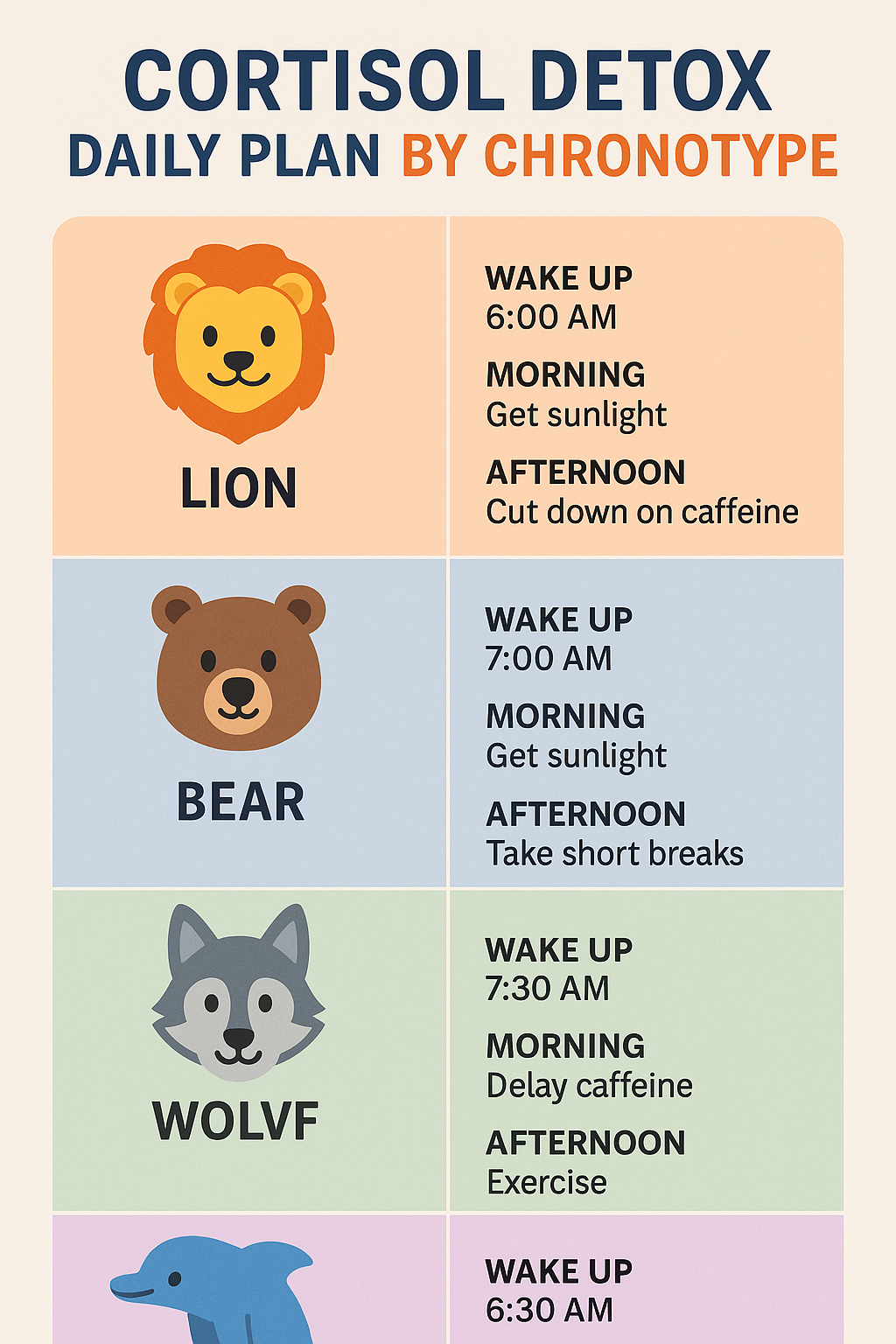
    Your chronotype determines when your body naturally wants to sleep, eat, and be active. According to sleep specialist Dr. Michael Breus, there are four primary chronotypes:

    1. Lion โ€“ Early risers, peak productivity in the morning, and fade by evening.
    2. Bear โ€“ The most common type, aligned with the sun. Energy peaks mid-morning to early afternoon.
    3. Wolf โ€“ Night owls. Struggle in the morning, but energised late afternoon and evening.
    4. Dolphin โ€“ Light sleepers with irregular patterns. Often anxious and hyper-aware.

    Understanding your chronotype allows you to time key activities like caffeine intake, exercise, and wind-down rituals to better support healthy cortisol cycles.

    Read Also: How Cutting Out Sugar Speeds Up Weight Loss: The Science, Benefits, and Sustainable Tips for Beginners

    Cortisol Detox Strategies by Chronotype

    ๐Ÿฆ Lions (Early Risers)

    • Cortisol Peak: Early morning
    • Challenge: Energy crashes in the afternoon
    • Detox Tips:
      • Engage in light morning workouts (e.g., walking or yoga)
      • Avoid caffeine after 10 a.m.
      • Power nap or relax during afternoon slumps
      • Use calming evening rituals to aid sleep (e.g., herbal tea, journaling)

    ๐Ÿป Bears (Solar Synced)

    • Cortisol Peak: Mid-morning
    • Challenge: Energy wanes if the routine is disrupted
    • Detox Tips:
      • Stick to a consistent wake-sleep cycle
      • Take screen breaks throughout the day to avoid overstimulation
      • Avoid late meals or alcohol before bed
      • Practice mindfulness during lunch or short walks in nature

    ๐Ÿบ Wolves (Night Owls)

    • Cortisol Peak: Late afternoon or evening
    • Challenge: Groggy mornings, alert late at night
    • Detox Tips:
      • Delay caffeine until at least 10 a.m.
      • Use a sunrise alarm to wake gradually
      • Schedule workouts in the evening
      • Avoid doomscrolling late at nightโ€”use blue light blockers

    ๐Ÿฌ Dolphins (Light Sleepers)

    • Cortisol Pattern: Irregular, often triggered by anxiety
    • Challenge: Poor sleep quality, overthinking
    • Detox Tips:
      • Follow strict sleep hygiene (no screens 1 hour before bed)
      • Try meditation or progressive muscle relaxation at night
      • Limit stimulants like sugar and caffeine
      • Use a weighted blanket or calming music to reduce anxiety

    Universal Cortisol Detox Habits (Good for All Chronotypes)

    Regardless of your chronotype, these strategies can support healthy cortisol levels:

    Read Also: Clear Nasal Congestion with Bay Leaves: The Power of Bay Leaves

    • Get early sunlight exposure โ€“ Signals your body to regulate cortisol naturally
    • Eat a balanced breakfast โ€“ With protein and healthy fats to stabilize blood sugar
    • Limit sugar and processed foods โ€“ Reduce cortisol spikes
    • Exercise daily โ€“ Choose the right time based on your chronotype
    • Prioritize restorative sleep โ€“ Stick to a regular schedule
    • Practice stress-reducing activities โ€“ Meditation, deep breathing, or nature walks

    Final Thoughts: Honour Your Rhythm, Heal Your Stress

    You donโ€™t need a one-size-fits-all routine to manage stress. Instead, aligning your daily habits with your chronotype helps you work with your body, not against it. By doing so, your cortisol levels naturally stabilise, leading to better sleep, less anxiety, and a more productive day.

    So, whether you’re a lion rising with the sun or a wolf who thrives under moonlight, your cortisol detox starts with knowing your rhythm.

  • The Sunday Reset Routine: 8 Ways to Organize Your Life for the Week Ahead.

    The Sunday Reset Routine: 8 Ways to Organize Your Life for the Week Ahead.

    My Sundays are truly dedicated for restingโ€”unless Iโ€™m unable to complete tasks I assigned myself the previous day. Iโ€™d rather use the whole of my Sunday for resting and taking good care of myself because how satisfied I feel by the end of the week often depends on how well I planned it. And all of this planning happens on Sunday.

    Today I want to share with you tips for creating a meaningful routine that will not only make your Sunday relaxing but also guarantee you an organized and fulfilling week.

    This is what I call the Sunday Reset Routineโ€”a structured but flexible approach to wrapping up the week, resetting your space, resetting your mind, and stepping into Monday with clarity and calm.

    Letโ€™s break it down.

    1. Start with the Non-Negotiable: Rest

    The Sunday Reset Routine: 8 Ways to Organize Your Life for the Week Ahead.

    First things firstโ€”Sunday should not feel like a second Saturday filled with errands and unfinished tasks. You canโ€™t reset properly if youโ€™re running on fumes. Even if you have things to get done, carve out time for real rest. This could be:

    • Sleeping in a little longer
    • Reading for pleasure
    • Going on a slow walk
    • Taking a long bath
    • Watching something light with zero guilt

    The key is intentional restโ€”not the kind where you scroll your phone and feel drained after. This sets the tone for the rest of your Sunday Reset Routine.

    Read Also: How Stress is Making You Grow and Look Older Than Your Age

    2. Reflect Before You Plan

    Before jumping into your to-do list for the next week, take a few minutes to reflect on the past one. Ask yourself:

    • What worked well last week?
    • What drained my energy?
    • What am I proud of?
    • What do I want to do differently?

    You can write this in a journal, type it out in your Notes app, or just think it through with your morning coffee. This short reflection gives you a sense of closure and helps you build your plan with intention instead of just copying last weekโ€™s template.

    3. Declutter Your Space (and Your Brain)

    The Sunday Reset Routine: 8 Ways to Organize Your Life for the Week Ahead.

    Itโ€™s hard to feel mentally clear when your space is a mess. A quick home reset goes a long way. You donโ€™t need to deep cleanโ€”just enough to feel like youโ€™re starting fresh:

    • Make your bed
    • Tidy your desk or workspace
    • Empty your trash
    • Clear out your bag or purse
    • Do a load of laundry if needed

    At the same time, clear your mental clutter too. Brain-dump everything floating in your mindโ€”ideas, errands, worries, remindersโ€”onto paper or a digital note. Once itโ€™s out of your head, you can sort through it and decide what actually matters this week.

    4. Review Your Calendar and To-Do List

    This is the โ€œget your life togetherโ€ moment. Look at your upcoming week:

    • Any meetings or deadlines?
    • Appointments or events?
    • Personal goals you want to make time for?

    Lay it all out. This is where planners, digital calendars, or apps like Notion or Google Calendar can help. Block time for your key priorities, but donโ€™t overstuff your schedule. Leave space for flexibility, rest, and the unexpected.

    If you often feel like your weeks run you instead of the other way around, this step is a game changer. Youโ€™re choosing how to spend your timeโ€”proactively, not reactively.

    5. Set 1-3 Main Intentions for the Week

    Instead of creating a massive to-do list, pick a few core intentions or priorities for the week. These might be:

    • Finish a specific work project
    • Cook at home three nights
    • Exercise four times
    • Reach out to a friend youโ€™ve been meaning to call

    These give your week a clear focus. Even if other things get chaotic, if you hit your core intentions, youโ€™ll feel grounded and accomplished.

    6. Do Light Prep (But Keep It Simple)

    Prepping for the week doesnโ€™t mean a full-on productivity sprint. A few small things can save you stress later:

    • Plan your meals or at least jot down a few dinner ideas
    • Prep one or two easy meals/snacks
    • Lay out outfits for Monday (or for the week, if that helps)
    • Refill your water bottle or coffee supplies
    • Charge your devices

    Think of this as setting yourself up for Future You. Just like youโ€™d clean up after cooking so tomorrowโ€™s kitchen feels freshโ€”this is the life version of that.

    7. Do Something That Fills You Up

    when to restart or push the reset button in your life comes as a feeling

    A Sunday Reset Routine isnโ€™t just about cleaning and planning. Itโ€™s about getting centered and intentional. So, include one thing that fills you back up emotionally or spiritually. That might be:

    • Journaling
    • A nature walk
    • Meditation or breathwork
    • Listening to music or a podcast you love
    • Doing a creative hobby like drawing or baking

    This is what makes Sunday feel restorative instead of like homework. It puts gas back in your tank so you’re not starting the week already drained.

    8. Pick a Wind-Down Ritual

    As Sunday evening rolls in, the Sunday Scaries might try to creep up. A solid wind-down ritual keeps that anxiety in check. Here are a few ideas:

    • Turn off email and social media notifications
    • Light a candle and make a cup of tea
    • Read a few pages of a book
    • Do a quick stretch or yoga flow
    • Write out your top three tasks for Monday
    • Go to bed on time (or even early)

    The goal is to transition out of weekend mode gently so that when Monday hits, youโ€™re not shocked out of a fog.

    Read Also: According to Health Experts, Here Are a Number of Ways to Manage Stress

    Why the Sunday Reset Routine Works

    This routine works because it respects the balance between rest and responsibility. It gives you permission to slow down and get ahead. It helps you be intentional instead of reactive. And when you start your week with clarity instead of chaos, everything feels more manageable.

    You donโ€™t need to do everything on this list. The point isnโ€™t perfectionโ€”itโ€™s rhythm. The Sunday Reset Routine is about tuning in, taking care of yourself, and preparing your life for the week ahead, your way.

    So next Sunday, donโ€™t just let the day slip by. Use it to reset. Youโ€™ll be surprised how much lighter and more focused you feel when Monday rolls around.

    Whatโ€™s Your Sunday Reset Look Like?

    Your reset routine doesnโ€™t have to match anyone elseโ€™s. Maybe you add something spiritual. Maybe you do a full skincare and journal session. Maybe you keep it super low-key. What matters is that it helps you feel organized, calm, and clear-headed.

    Try a few of these tips next Sunday. See what sticks. And remember: rest is productive. Planning is powerful. And the Sunday Reset Routine is where they meet.

    Want a printable checklist or template for your Sunday Reset Routine? Drop a comment or messageโ€”Iโ€™ll send it your way.